
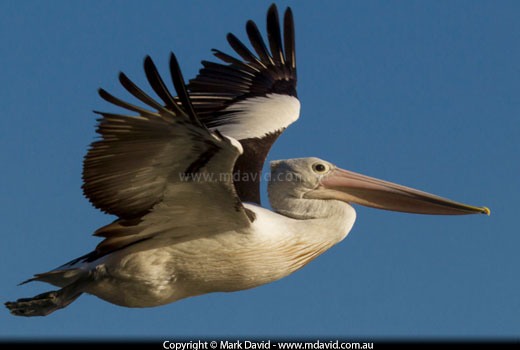
Australian Pelican (Pelecanus conspicillatus)
You sometimes hear that pelicans use that stretchy lower part of their beak to store food but I don’t believe that’s true. Instead, they use it more like a net to catch fish. They will dip their beak into the water and then lift it out again, allowing the water to drain out with the fish (hopefully) trapped inside.
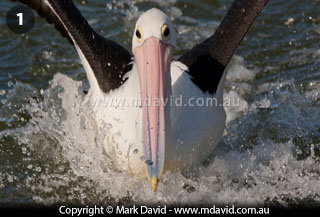
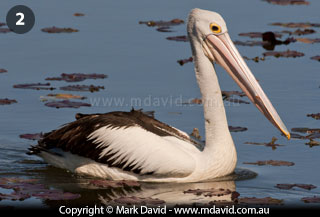
1: An Australian Pelican coming in for a water landing makes an impressive splash. 2: Paddling over the glassy surface of a Sydney pond
I’ve watched pelicans use the beak as a net to catch thrown scraps of bread but I don’t like the idea of feeding bread to pelicans — or any other birds. Bread might be great food for humans but, despite the fact that many types of birds will rush for scraps of bread, in a lot of cases it does them no good at all and can even be bad for them.
Pelicans are superb fliers. The photo at the top of this page shows a pelican in its typical flying position with its head in and feet up. They become very aerodynamically efficient like that and this helps them cover some impressive distances, using thermals to gain altitude and plenty of gliding to cover lots of ground.
I’d like to say pelicans always looked as graceful as they do in the air, but they don’t. On land they look clumsy, bordering on comical, getting around on those webbed feet.
On a trip across the Hay Plains of inland NSW I once encountered the biggest flock of pelicans I’ve seen. It was after a series of drought-breaking falls of rain so my guess is a bunch of them were heading for their breeding ground.
How a bird which often hangs around the coast knows when conditions are good inland is difficult to figure out, but those ones knew something was going on. Vast flocks numbering in their thousands will, when the conditions are right, accumulate for nesting and breeding — sort of a pelican fertility festival.
Each pair will look after a couple of eggs and share the job of feeding and raising the chicks. The young don’t have feathers when they hatch and so they are vulnerable to the bright sun. If you see a mature pair of pelicans, the big one will most likely be the male, and if they are nesting it’s a good idea not to approach the nest. Many species of birds, including pelicans, will sometimes abandon their chicks permanently if they see people getting too close to it. That’s why I only photograph nesting birds from a distance.
Reader’s Digest Complete Book of Australian Birds
Reader’s Digest Services Pty Ltd, 1979
Simpson & Day, 1993, Field Guide to the Birds of Australia
Viking O’Neil, Penguin Books Australia Ltd


Copyright © Mark David. All rights reserved


