
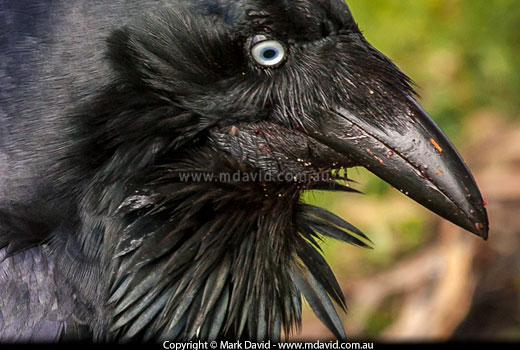
The thick cluster of neck feathers (called hackles) help identify this bird as an Australian Raven.
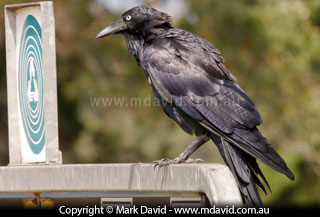
Corvus coronoides
The only white you’ll see on these shiny black birds is their eye (which is also blue). The base of their feathers is grey, but you’re not likely to see that. One feature of the Australian Raven which you are likely to see is the thick, long, beard-like clump of feathers on its throat, called hackles. These are impressive, big birds with a call that sounds something like ‘arrrr, arrr, arrrrrrrr’. That sound could almost be mistaken for human. More information here.
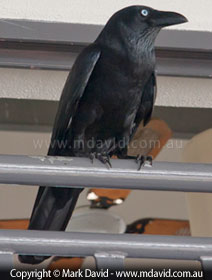
Corvus orru
Like the Australian Raven, these birds have a white eye and are covered all over with black feathers, but the hackles (neck feathers) are much less prominent and the bases of the feathers are white. Also, they aren’t as big as the Australian Raven.
These are the birds you’re likely to see across an area stretching along the Queensland coast and into northern NSW. You might also see them in Western Australia, Northern Territory and the northern-most bits of South Australia
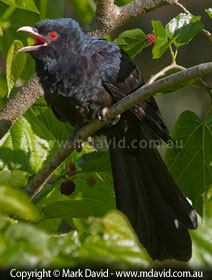
Eudynamys orientalis
Also sometimes called the Koel Cuckoo. The male is an impressive black bird with bright red eyes. Females are patterned brown and white. There’s a good chance you’ll hear them before you see them due to their extremely loud call. These birds live in New Guinea and far northern Australia during winter and then fly south to breed in spring. They lay their eggs in other birds’ nests (birds of other species) and then take off, leaving the host birds to do all the work raising the chicks.
I don’t want to suggest the Koels have it all that easy though, because flying from New Guinea to Sydney and back doesn’t sound like light work.
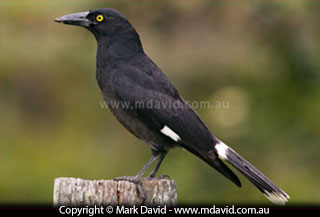
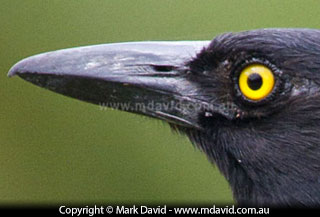
Strepera graculina
The word ‘Pied’ in its name tells you this bird is more than just black. Those little flashes of white on the wings and tail tell you you’re not looking at a raven or a crow. A bright yellow eye and a bill which is slightly hooked at the end also help to identify these birds.
Currawongs will eat berries, insects and other small animals. They are even known to sometimes take the young from other birds’ nests. Perhaps that’s why I’ve seen them being harassed and chased by smaller birds like Willy Wagtails.
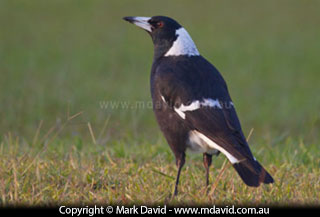
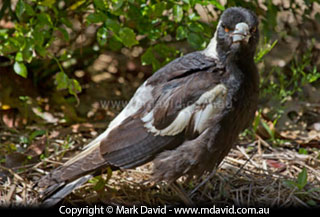
Gymnorhina tibicen
That’s the adult bird in the first photo and that one with lighter feathers in the next photo is a young one. So if you see one of the young ones you’ll almost always see some adult birds nearby. These birds are often seen walking around in a small family group feeding on the ground.
Look for the white on the back of the neck and a beak which is bluish-grey tipped with black.
More photos and information about Magpies here.
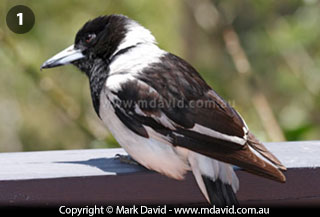
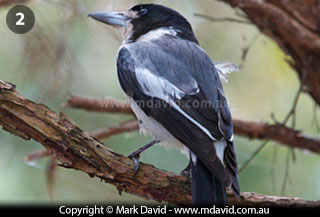
Number 1 is a Pied Butcherbird (Cracticus nigrogularis) and number 2 is a Grey Butcherbird (Cracticus torquatus). You could easily mistake these birds for Magpies until you notice that they’re smaller and stockier and have a clearly hooked beak. These birds have a beautiful call and it’s worth pausing to listen when they’re in full song.
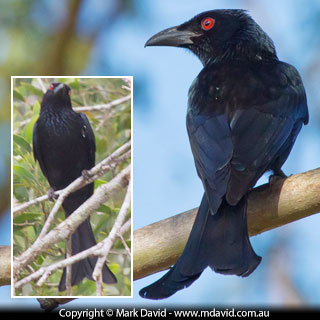
Dicrurus bracteatus
In Australia the word drongo means a no-hoper, an idiot, a fool… So when people ask me what kind of bird this is and I say it’s a Spangled Drongo it always seems to get a laugh.
However the Spangled Drongo is a handsome bird with a very distinctive mix of red eye, forked tail, glossy black feathers and greenish ‘spangles’ on its chest. It’s a very capable flier too, catching insects in mid-air. If only they’d given it a more dignified name. Like perhaps Red-eyed Drongo.
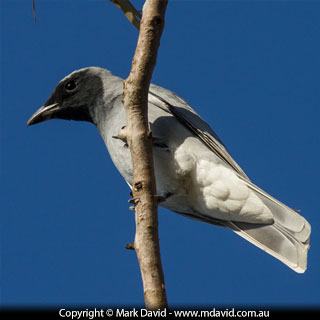
Coracina novaehollandiae
Here’s a bird you might see in Australia’s west as well as the east. The bird is grey on its back and paler grey underneath, but it’s the black mask and throat that really draws attention and gives its identity away. A small expanse of white plumage on the undercarriage just barely qualifies it for entry into this listing of black and white birds.
There’s actually another bird called a Masked Woodswallow which kinda, sorta looks the same. But that bird has a clear white crescent around the base of the black mask. By contrast, you’ll see that this bird has the black mask ending in grey plumage.
They feed on small invertebrates and are quite common.
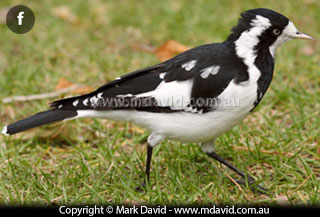
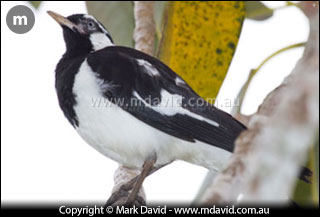
Grallina cyanoleuca
At first glance these birds almost look like miniature Magpies. They have a much smaller beak than the Magpie, but like the Magpies they will often be seen wandering around on the ground. The bird in the photo marked with an “f” is a female. You can tell that by her white face and throat. The male, which in a fit of creativity I’ve marked with an “m”, has the black face and throat.
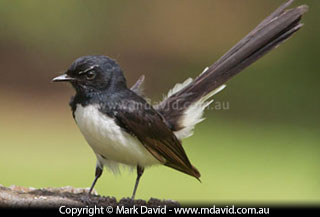
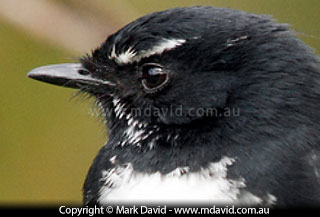
Rhipidura leucophrys
Willie Wagtails will often be seen hopping about a lawn, swishing their tails from side to side. I enjoy having these birds around. They seem to always be lively. They have two very different calls — an alarm call which is a sort of metallic chkkttt chkkttt chkktt sounding like someone shaking a jar full of nails, or a sweet song-bird call about as unlike a jar of nails as you could imagine. That song-bird call, by the way, sometimes goes on and on at night.
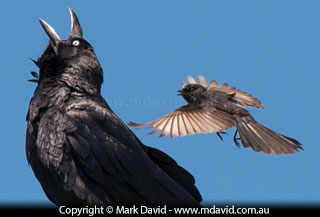
As much as I like them I’m glad they’re not the size of a dog because they can be a little bit aggressive and quite fearless too. I often see them chasing or harassing much bigger birds like Ravens, as is happening in this photo, and occasionally one will stand its ground and give me an indignant blast of chkkttt chkkttt too. The one in the first photo is looking a bit wind-blown but normally they are a sleek-looking bird. Look for the black-all-over head and their crazy white ‘eyebrow’. Size is about 20cm. These birds can be found all over Australia.
Myiagra inquieta
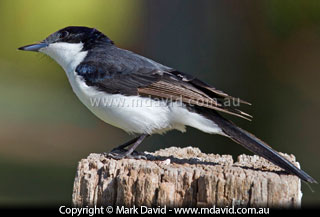
This bird is easily mistaken for a Willie Wagtail. It looks similar, is about the same size, and often hangs around in the same area. But there are differences which make identification easy.
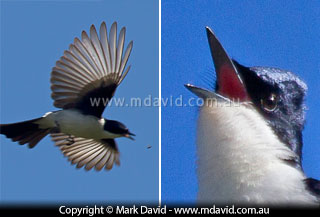
See how the bottom half of the bird’s head is white, whereas the Willie Wagtail’s head is black all around. That’s the bit I look for. The Restless Flycatcher has a bluish tinge to its head too, and sometimes you’ll notice a bit of a crest.
They have an impressive ability to ‘hawk’, which means to leave their perch in the tree and snatch their prey in the air. And another name for hawking is flycatching. The ‘restless’ part of their name is well deserved too. They’re an active bird, often hovering around the foliage of trees or moving from one tree to another. In one of these photos we see a Restless Flycatcher catching an insect in mid-air. And yes, it did catch that insect.
Copyright © Mark David. All rights reserved