
In the 1960s some Australian White Ibises were caught in northern Victoria and brought down to southern Victoria, to put into an aviary. They managed to breed, so some of the offspring were allowed outside the aviary, and wild birds were lured in to breed with them. You’tve probably already guessed where this is going. By 1980, that small flock had grown to 1,600 birds.
Sydney’s Taronga Zoo have their own story to tell. They too, started a colony, breeding them and allowing them to roam free in the zoo grounds. It was the first time the birds had bred so close to Sydney, and the ibis seemed to like the idea.
That colony increased and has now spread all around Sydney. In some schools, the teachers train children how not to be intimidated by ibis. Otherwise the birds have been known to run up to the little kids and snatch their sandwiches out of their hands. The birds turn over bins and spread rubbish, hang around cafes, and dominate some of the best nesting spots that might have been used by other species.
They have also been known to cause a nuisance for captive animals at wildlife parks. At feeding time the ibis run in and grab the food meant for other animals.
Being a large bird, a flock of them is dangerous around airports, because if a plane hits one it can damage an engine.
They also cause a problem with their droppings. It doesn’t take a science degree to figure out that big birds make big droppings. Where lots of ibis leave a mess in public places, those areas can become unhealthy for people.
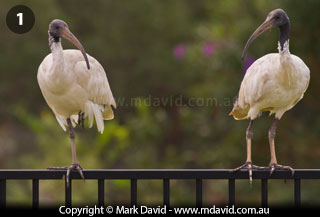
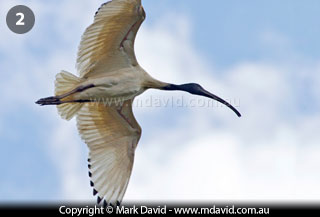
1: Australian White Ibis 2: These birds are graceful creatures in flight.
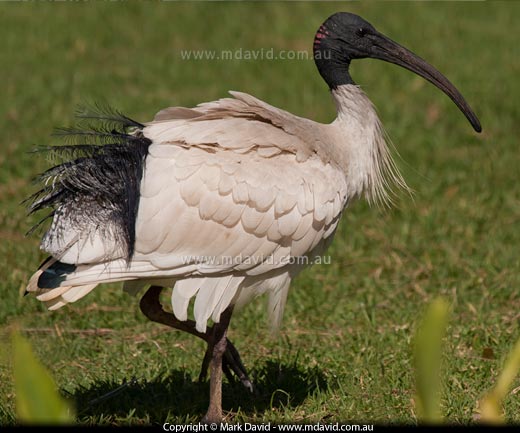
It’s not difficult. They’re a fairly big bird (about 70 cm long) and they are almost entirely white, with a black head and neck and a long curved beak. The pictures on this web page should make them pretty easy to identify.
These birds are mainly found in eastern and northern Australia. They like to hang around in swamps, lagoons, grassy areas, parks and rubbish tips.
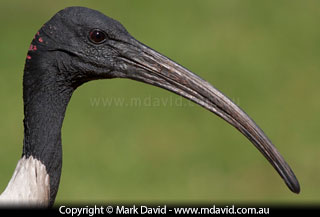
Close-up detail of the head
Absolutely not! They are just birds being birds and they are also very beautiful. The point is not that any kind of bird is bad, but that when you introduce animals, even indigenous ones, into a region we often can’t fully predict the consequences. I’m glad we still have our Australian White Ibises, but I also know that a lot of work is now done by rangers behind the scenes to control their numbers in areas where they were on the verge of getting out of hand, including parts of Sydney. That includes things like replacing their eggs with fake ones, and other humane ways of managing their numbers.
The answer is more, what you shouldn’t do. Feeding wild birds at picnic spots contributes a lot to some of their worst behavior because it can make a bird behaving peacefully into something more aggressive. So don’t feed them. Also, don’t leave your rubbish lying around where ibis can find it. Although, not leaving rubbish lying around is a pretty good idea anyway.
Feeding wild animals might be fun but it can do a few things which I don’t think are so good. First, it can make animals forget their natural tendencies to be wary of people, to the point where they can start being aggressive, especially towards little children. Second, it leads to an imbalance in their diet which can cause obesity and hurt the development of their young. And even if you make sure you feed them exactly the right foods, feeding wild animals can lead to the point where they depend on you so much that they can starve to death once you go on holidays or move to another area.
For these reasons the best way to enjoy wild birds is to look after the environment where they (and we) live and then let them get on with their lives naturally. In other words, just let them be birds.
The story of the Australian White Iibis shows us that nature sometimes does things we can’t predict. That’s why we should be careful about how we change things. Even Australian birds can surprise us in Australia.

Copyright © Mark David. All rights reserved