
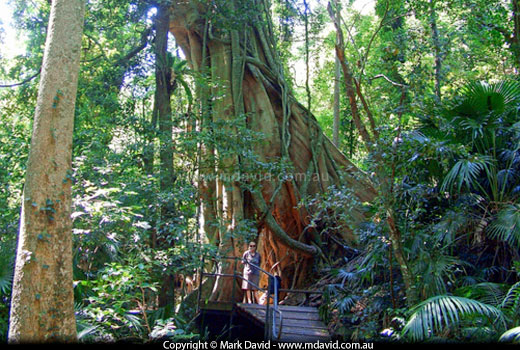
Strangler Fig growing in Minnamurra Rainforest, NSW
Australia has some amazing trees and some of the most bizarre are the stranglers.
These trees can eventually become the forest giants but they have an unusual start to life: most of the time they begin by growing on another tree.
It all starts when a bird eats a fig from a mature tree and then flies off to perch in the fork of another tree. Seeds in droppings left behind by the bird can germinate and produce a tiny plant growing in the fork. From here on, the story is explained in the slide show below.
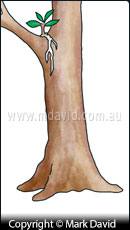
The seedling sends roots creeping down the tree trunk. Click the “Next slide” button below to continue.
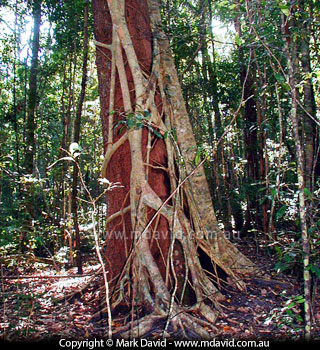
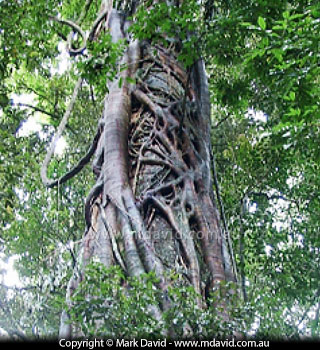
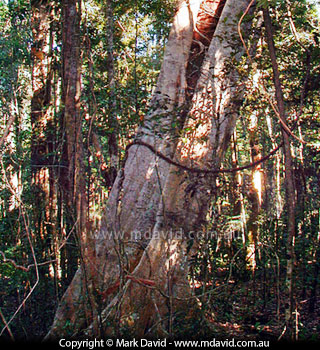
In these three pictures you can see different stages of the strangling process. In the last image only a small portion of the host tree is visible.
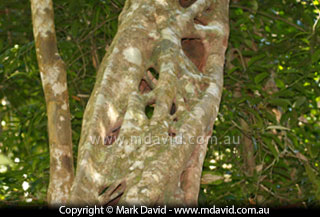
Sometimes you find a Strangler Fig like this one. The host tree inside has died and completely rotted away, leaving a towering hollow mesh of fig tree. Notice that you can see right through the trunk.
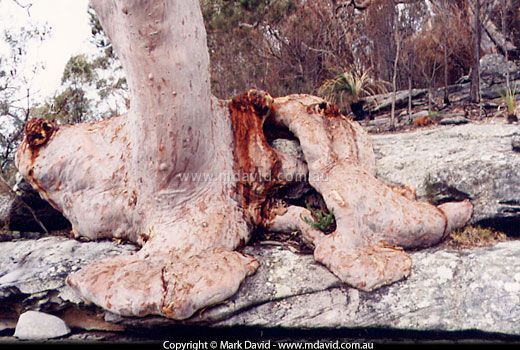
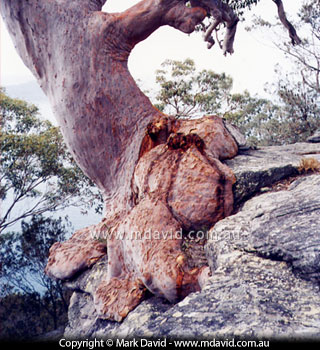
I took these photos of this Angophora costata growing in Kur-ring-gai Chase National Park in approximately 1990. My guess is it had first grown out of a crack in a cliff face. Then as it got older its base spread over the surrounding rock, giving the impression the tree was melting and oozing down the cliff.
I often used to visit this tree to chill out and recharge from the stress of the high-pressure job I had at the time. So it was one of my favourite places.
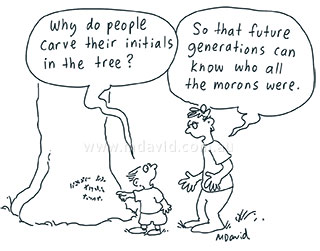
One time I visited this tree I was unimpressed to see someone’s initials carved into it. I dedicate this cartoon to that person.
The very last time I visited that spot I was stunned by what I saw. During a manic splurge of construction, in which the area’s natural beauty was plastered with an outbreak of new toilet blocks, more toilet blocks, car parks, stairs and a bewildering amount of ugly metal railings, this tree found itself fenced off from view. Mind you, I don’t want to sound too critical — after all, the public was still given full access to a view of the fences and toilet blocks.
I’m all in favour of making nature accessible in a safe way, but not if making it accessible is done in a way that wrecks or obscures the very nature you want to access. In my opinion, the new high metal fence (which would make these photos impossible today) make an eyesore out of the area and after visiting this tree so many times to chill out over more than 20 years I admit to having left the area feeling pretty sad. I haven’t gone back either. It’s a bit like going to the art gallery to see your favourite painting and having to steal a glimpse at it through a wall of high barriers, hand rails and signs saying ‘Welcome to the painting.’ Accessibility gone mad.
Thankfully I still have my memories and photos.
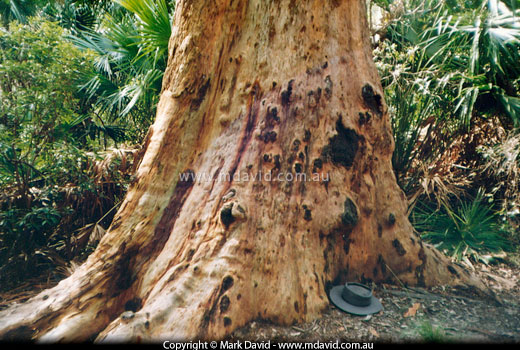
One tree that made a big impression on me was the lovely big old Angophora costata shown here. I took this pic when the tree was still alive and although I can’t confirm it, I believe it was the largest Angophora costata in the world and was clearly a very significant tree. It towered over the surrounding forest and had a very impressive, large base. To give a rough idea of its size, that’s my old hat alongside it. Yeah I know — that photo hardly makes it look special but for an Angophora it really was.
Shortly after I took this photo the tree was savagely pruned into a symmetrical blob, presumably to make it look more “balanced”. I was stunned by the level of butchery, because the healthy branches had been removed and stacked into a pile next to it, while the dead or diseased wood was left attached! Predictably, it immediately died right after that.
Also, trying to “balance” a tree is something best left to the experts, because trees know more about balance than we give them credit for, and create the necessary root structure to balance themselves, and often lack the necessary root structure to support themselves if you go and change everything above the ground. All too often, well-meaning but inexperienced tree pruners chop a large branch off a tree to help balance it, only to find the that after a decent wind the tree falls over the other way.
Seriously, that marvellous thing was killed before its time, but to be honest, I’m certain it would be dead by now anyway. Because on the side of the trunk which you can’t see in the photo there were some fruiting bodies of fungus growing out of it. That’s never a good sign. It means fungus has spread throughout that part of the tree, indicating that it’s rotting and being eaten away and dying from the inside. When there’s fungus growing out of a tree trunk I don’t think there’s much you can do to save it. Still, it would have been nice if the tree had been trimmed in a way that was more helpful than only chopping off the healthiest branches and leaving the dead ones.
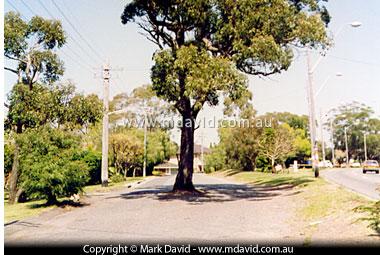
Now you see this is what happens if you don’t repair a pothole. This tree was growing out of the middle of road.
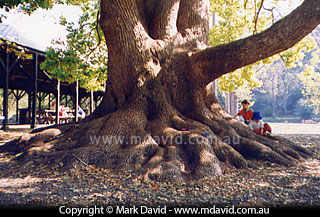
This shows why it’s not a good idea to plant a Camphor Laurel next to your driveway. They can get big and their root system can form a giant mound that lifts whatever’s above it. These kids in the Royal National Park had a great time crawling over the tree. The Camphor Laurel, though, is considered a noxious pest in many areas.
This impressive big tree was poisoned by vandals and had to be removed for public safety. One of the rangers told me she thought the vandals were trying to prevent the tree’s seeds from spreading into the nearby bush.
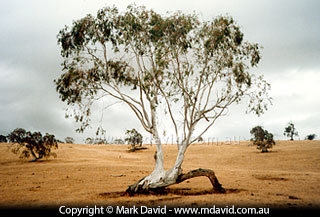
You can usually look at the base of a tree and figure out how it grew, but to use an awful pun, this one had me stumped.
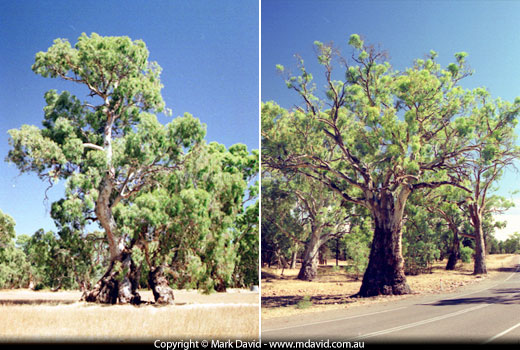
The River Red Gums in South Australia have had a rough time, with droughts and high temperatures. To make things worse, they’re not receiving the same amounts of floodwaters that once nurtured them. So I was happy to find these old photos which I took in about 1995, showing some big River Reds in good health. The one on the left is so old that its trunk had divided into three. The one on the right was just plain big.

Copyright © Mark David. All rights reserved