
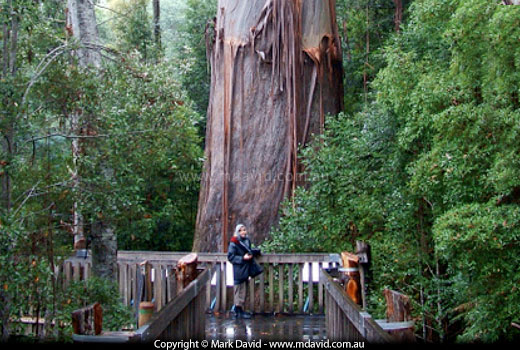
How do you make a big gum tree? First, plant it hundreds of years ago. Shown above, the Arve Giant in Tasmania
Eucalyptys regnans is a fast-growing gum tree native to high-rainfall areas in the Australian states of Tasmania and Victoria. It holds the record for the tallest hardwood in the world. Some of biggest regnans could give some of the big sequoias a run for their money in terms of size and could even beat the tall redwoods for height. But you need a lot of things to go right to make a giant regnans.
First, it has to be growing in an area with good soils and a tremendous amount of rainfall — the very kind of land watched with envy by plantation owners. In the first years of its life the young tree should be surrounded by tall trees, forcing it to race towards sunlight, in its fast-growth early years. The tree then has to survive hundreds of years of fires, pests, disease, storms, lightning strikes, and of course, logging. It also needs a permanent stand of trees around it to protect it from exposure to storms and erosion.
Run the slide show below to see some of the processes involved in producing a giant.
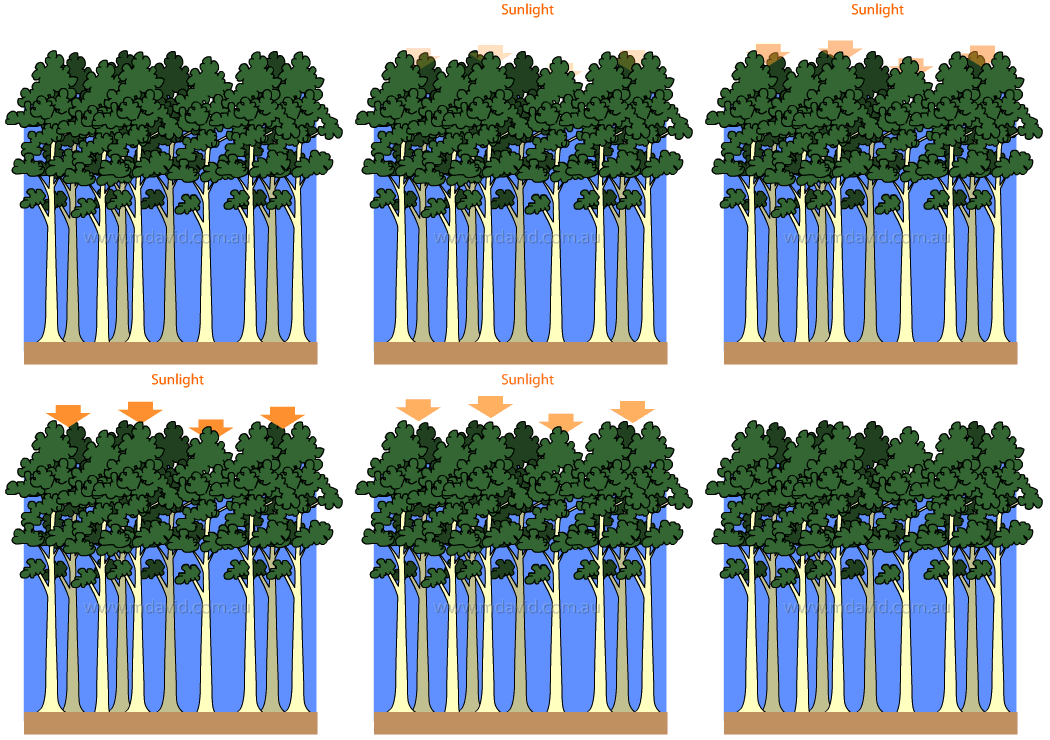
A stand of mature trees. Very little light reaches the forest floor because the canopy of leaves blocks most of it. At ground level the soil is kept moist and shaded. Any young tree that germinates in those dark conditions is unlikely to thrive. Click the “Next slide” button below to continue …
If you compare the sequence in the slide show with what’s happening now you’ll realise that these perfect conditions are unlikely to happen again.
The few giant trees that are spared from logging have everything around them chopped down. This leaves them standing exposed and vulnerable to lightning strikes, erosion and wind damage. The ground around the tree is no longer shaded and becomes drier and harder than it once was. With all these things working against it, the giant is likely to die much earlier than it should have.
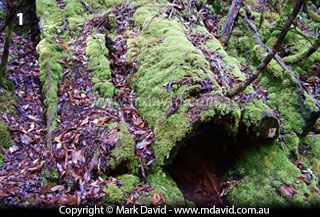
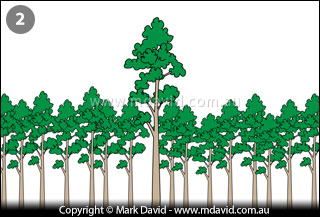
1: This ancient log used to be the trunk of a forest giant. It’s slowly decaying into the soil, providing nutrients for the next generation of trees. 2: Which of these trees would you most expect to be struck by lightning? The practice of leaving a single giant results in it being especially vulnerable.
There are lots of things getting in the way.
When you consider how difficult it is, and how long it takes to make a giant, it seems crazy to chop them all down for woodchips — a product which is basically the same as mulch. I visited Tasmania in the early 1990s to see the great forests while it was still possible. I’m glad I did, but I also feel sorry for people younger than me who missed the chance, because most of those spectacular forests I saw are already gone. I just wish I’d taken more — and better — photos.
The last great area I saw briefly, with some of the most gigantic trees I thought possible, was the Styx Valley. When I went there in the early 1990s I was told by a forestry official that legislation had ensured that the Styx Valley would never, ever be logged. I was even considered a fool and a bit of a troublemaker for suggesting that might change one day. Of course at the time of writing this web page it is the new area planned for extensive logging.

Copyright © Mark David. All rights reserved


