
Brush Turkey
I’ll never forget my first visit to Noosa. As soon as I got there I headed for the national park and within minutes was happy to discover a wild Brush Turkey (Alectura lathami) in the rainforest. I felt proud of my nature-finding skills. Then I went down to busy Hastings Street with its shops and tourists and got a better idea about how clever I’d really been. It turned out that Brush Turkeys were everywhere, wandering the street, strolling down the footpath and even pausing by cafes. In fact the birds were so common that some of the locals were tired of them wrecking their gardens.
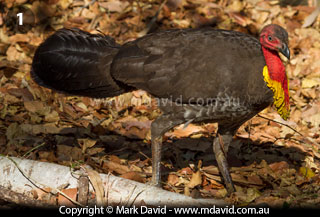
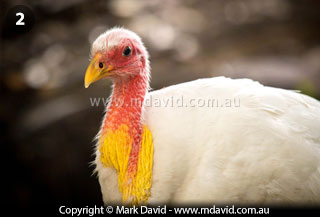
1: Male Brush Turkey photographed in breeding season 2: A very unusual white specimen. The black eye on this bird reveals that it is not an albino, so the white plumage is probably caused by it being leucistic.
The truth is that these birds are more common in the steamy northern rainforests than the cooler, drier areas down south. But the sheer numbers of the birds there still surprised me.
Brush Turkeys are ground-dwelling birds although they can fly if they need to. In the bush you’ll see them scratching around the damp ground looking for insects, fruit and seeds. Towards dusk you might see them flying up to roost overnight in a tree.
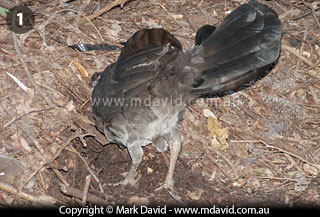
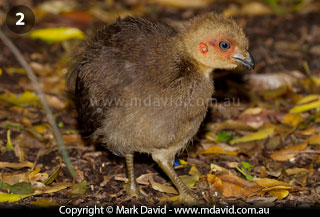
1: The male plunges his head into the nest to determine the internal temperature 2: A young Brush Turkey
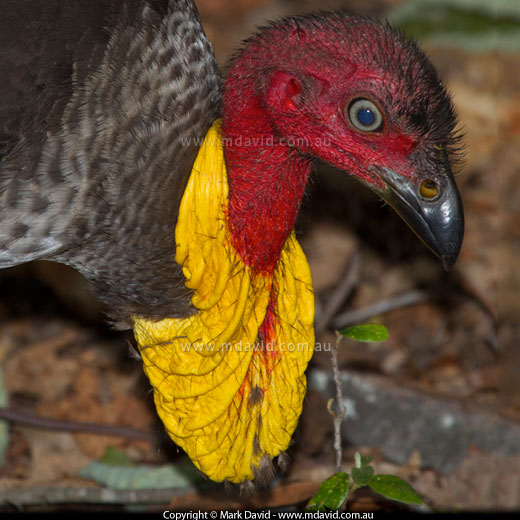
Brush Turkeys are big black birds, about 70 cm long with a red head and neck. At the base of the neck there’s a frilly yellow bit (bigger and more noticeable in the male). The tail is black and flattened into a vertical plane like a ship’s rudder. Very occasionally people see a white Brush Turkey. I don’t know if those birds are albinos or not.
They live along a mainly coastal strip from about Sydney to the northern-most tip of Queensland on Australia’s east coast. They used to be more widespread but the clearing of rainforests, plus people shooting them illegally, have reduced their range.
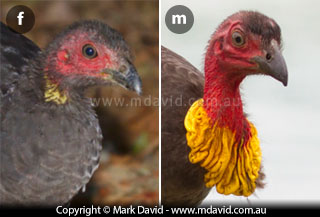
The female (f) has a smaller collar than the male (m). The female also has a thicker covering of feathers around her neck.
These birds are well known for their huge nests. The male flicks loose leaves (or it might be someone’s carefully-raked mulch or vegetable garden) from the ground with his feet, building the stuff up into an impressive large mound. By the time he’s finished he has a pile of leaf material about a metre high and 4 metres across.
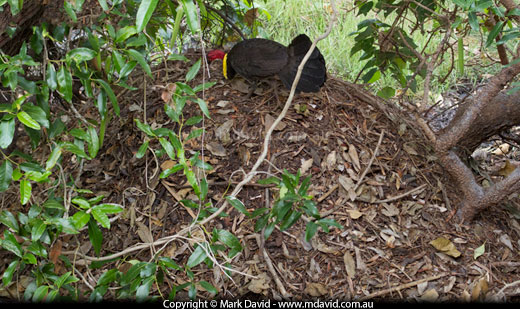
A male Brush Turkey is dwarfed by his nest.
Just like in a compost heap, the leaf material starts to decompose and the fermentation creates heat which — you guessed it — incubates the eggs. The bird makes sure things don’t get too hot though — he wants the eggs incubated, not hard-boiled. To test the temperature of the mound he digs a hole and sticks his head in it. If it’s too hot he digs up bits of the mound and releases excess heat to ensure a nice egg-friendly temperature.
The female is allowed onto the mound for mating and egg laying. She digs a small hole in it, lays her egg and then scratches some leaves over it. This goes on every two or three days until there are a couple of dozen eggs.
About 50 days later, the chicks start hatching and fight their way to the surface. They scamper off into the bush and look after themselves, living alone.
If your vegetable garden has just been trashed by a Brush Turkey then chances are you’re not a big fan of these guys. But I really like them. The truth is that the male birds have a strong nesting instinct, which means they can be compulsive at scratching up leaves, and we have to learn to live with that. I’ve also heard stories about these birds driving snakes away by pecking and harassing them. Now, I can’t confirm those stories — I sure know I wouldn’t bet my exposed ankles on the theory — but hey, who knows? If you live in areas where venomous snakes are a bother then just maybe you can feel a bit reassured having these birds around.

Copyright © Mark David. All rights reserved


