
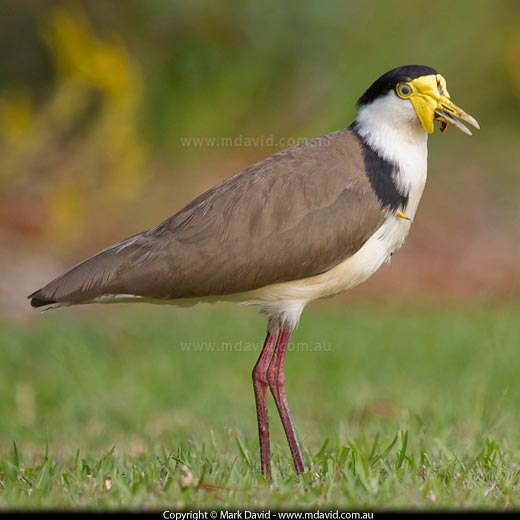
If you’ve ever been or even known a parent you’ll appreciate that raising kids is a full-time job. Now imagine that you’re about the size of a football, and that you tasted like what a fox would call lunch. Also imagine your home is nothing more than an exposed, windy patch of ground in the middle of a field. If that’s starting to sound like a tough gig then you’ve got your first glimpse into the remarkable family life of these birds.
Even as I write this article, I can hear the raucous sound of a pair of nesting Lapwings nearby. The loud rapid-fire ‘ki-ki-ki-ki-ki’ alarm call, sounding more like something coming from a small brass instrument than a small feathered animal, lets me know that someone or perhaps even a dog is wandering past. You’ll hear it a lot if these birds decide to breed in your area, but before we delve further into matters of lapwing love, here’s a bit more information about them.
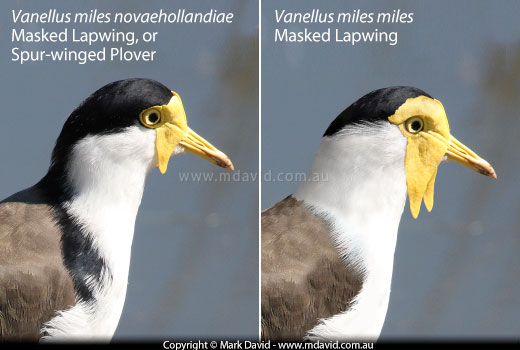
Digitally altered Lapwing: the picture on the right has been manipulated to show the differences in appearance between the two subspecies.
These birds live in Australia, Indonesia, New Guinea, New Caledonia and New Zealand.
In Australia there are two types of the one species, and both can be called Masked Lapwings. Across the northern parts of the continent there’s a sub-species which scientists call Vanellus miles miles, and in the southern regions a slightly different looking critter called Vanellus miles novaehollandiae. It’s that southern variety which you can also call a Spur-winged Plover.
So you can play it safe and call them all Masked Lapwings, or you can learn to tell the two sub-species apart, because that’s easy to do. I’ve digitally manipulated a picture of a Masked Lapwing in the pictures above, to help. You’ll see that the northern birds have bigger yellow wattles over their face and no black bands on their shoulders.
By the way, the southern sub-species was the one that managed to find its own way to the south island of New Zealand and since then it has spread north across the country.
Here’s a prediction: you’ll never hear it said that Masked Lapwings feel uncomfortable in open spaces. The birds love walking around wide-open areas close to water, whether they be grasslands, mudflats or beaches, and they seem not to be the least bit bothered if the area had been cleared naturally or with a mower. In fact they even feel at home walking around football fields (their colours suggest they’re Hawthorn supporters). Other places you might see them are on airfields and even the grassy strips beside busy roads, as they hunt down their diet of grubs, worms and insects.
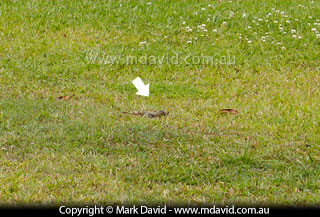
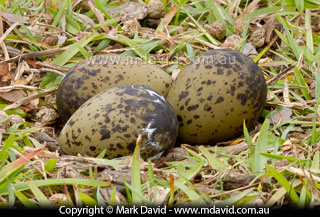
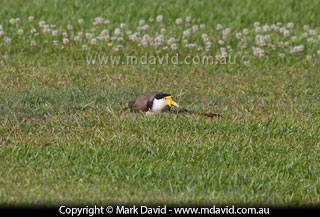
A typical Masked Lapwing nest in the middle of our yard. It was littered with small objects which enhanced the camouflage effect of the spotty eggs. Most of the time one of the birds was on the nest, but sometimes both birds would wander off for a feed. When that happened it was surprisingly difficult to see the eggs until you were right up close to them.
Around late winter and spring, their preference for open spaces becomes even more surprising, as the birds prepare to breed. While many other species look for a nesting place offering shelter and concealment — if I was a bird that’s what I would do — our friends the Masked Lapwings go the other way. They find a spot that seems to be as exposed as possible. It could be right in the middle of a playing field, or on top of an empty garden bed. The birds don’t spend time on elaborate nest construction either — usually it will be just a slight recess in the ground into which mum lays up to 4 eggs.
One of the parent birds on the nest. The grass is starting to look a bit messy because I stopped mowing there while all this was going on.
It’s at this point in the story that the Masked Lapwings lose some of their appeal among people who don’t properly understand their intentions. If you happen to walk near the nest then chances are you will first be greeted by the birds’ alarm call. Wander even closer and one or both might take off and swoop near you while filling the air with their high-pitched calls. Some people might call that behaviour aggressive, but it actually makes sense when you see realise that the birds are only trying to protect their eggs, which are sitting exposed and vulnerable on the ground. And most of the time, all that noise and swooping is just bluffing. It’s not normal for the birds to actually strike people.
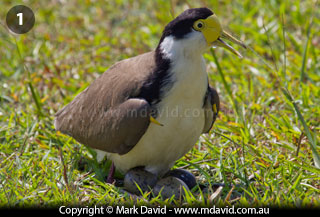
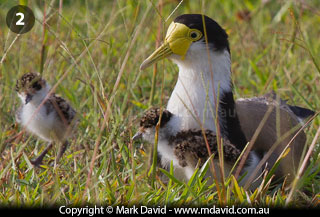
1: One of the parent birds standing over three eggs. 2: The scene a month later, with two of the chicks hatched that day. Despite being only hours old, they were already starting to go for short walks around the parent bird. I hadn’t mowed there for more than a month by that stage!
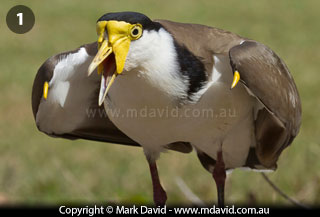
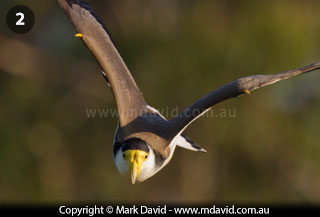
1: One of the parent birds stands its ground near the nest. 2: One of the parent birds swoops towards me when I walk near its chicks, in an attempt to drive me out of the area. I don’t deliberately antagonise wildlife but in this case the birds would swoop me whenever I stepped out my front door (which is where I took this photo). If this happens to you, tell yourself that the young birds will be grown up soon and the swooping will then be over.
The most obvious thing is to find a different path to get around the birds. That might seem like a big imposition at first but usually it’s not such a big deal. If you must go near them then wearing a hat and eye protection can be a good idea. Travelling in a group can also encourage the birds to keep their distance. And if you’re on a bike then you might want to think about dismounting and walking through the area.
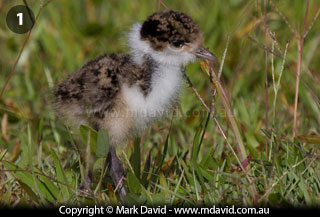
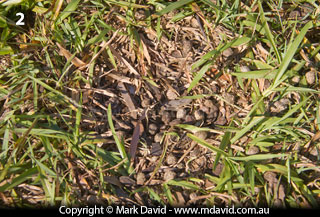
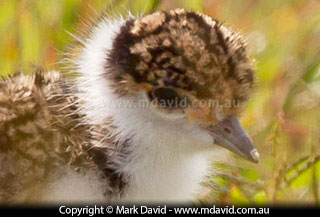
1: One-day-old Masked Lapwing chick. 2: The nesting site after the birds had moved on. Once all the eggs were hatched the birds didn’t hang around long. They turned out to be good tenants too — leaving the place as they found it and not trashing the place! Even the egg shell fragments were gone.
Both parents take turns sitting on the eggs and it normally takes about a month for the eggs to hatch. If you thought the parents had a tough job up until now, the real fun begins when the chicks emerge. Those young don’t muck around — they’re keen to get going as soon as possible, which means they are on their feet and exploring within hours of hatching. In fact you might even notice one or two chicks checking out the immediate area while their siblings are still in their eggs. During those early days the chicks are, like the eggs, camouflaged with spots and so it can be quite difficult to see them until they move.
The chicks are able to feed themselves from day one but in their first weeks they are covered with soft down and are unable to fly. So once they’ve all hatched the group starts moving around the local area on foot.
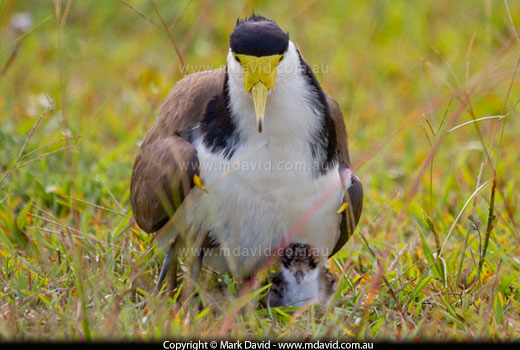
Four birds. Yep, it’s possible to count four birds in this shot. Hint: one of them wasn’t hatched yet.
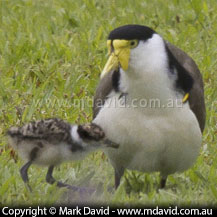
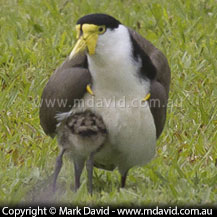
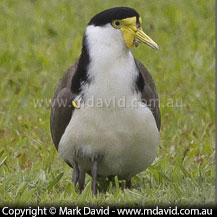
Two birds: A Masked Lapwing chick buries itself into its parent’s feathers. I’ve seen two chicks hide in the plumage of a single bird at once and only the presence of a suspiciously large number of legs revealed that anything was going on.
The parent birds have a full-time job keeping the family together as well as out of harm’s way. Mum and dad both take an active role and you’ll hear a whole lot of calls from them at these times too. In fact, it’s likely that you’ll hear the group approaching long before you see them. That reminds me of some human families I know but this is a wildlife story so I won’t dwell more on that.
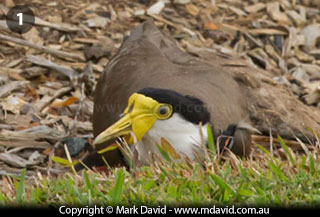
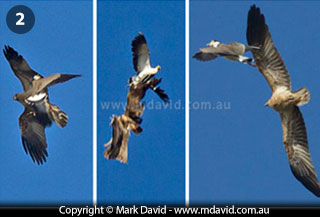
1: One of the parents runs away from its young and drops to the ground pretending to be injured. This trick is probably meant to lure potential predators away from the chicks. 2: A Masked Lapwing attacking a Brahminy Kite in the air. The Masked Lapwing appeared to show no fear of the Kite and some of the attacks were so aggressive that they resulted in the much larger bird falling tens of metres before regaining control. I don’t know if that Lapwing was looking after chicks at the time, but the Kite was clearly a potential predator of young birds
If something big and scary wanders nearby then the parents jump into action. First thing you’ll hear is their alarm call, which is the raucous ‘ki-ki-ki-ki’ sound mentioned earlier. There might be a bit of swooping too, but once again I’ll stress that if you’re not deliberately provoking the birds then that swooping will probably just be a whole lot of bluffing.
There’s another really smart trick which they often use when a potential predator comes close. While one parent leads the kids away from danger, the other one sprints off in the opposite direction and then start limping, and then collapsing to the ground in a way that suggests it’s been injured. Such a performance is bound to make it look vulnerable and easy to catch, and so all the more enticing to predators. It will lie there in a sort of crooked way, appearing to be unable to escape. If the predator gets closer it then it will then suddenly jump to its feet and take its act even further from its offpsring. While all this is going on, the young might be hiding and huddled close to the ground.
When the danger has passed, both parents return to the young and that’s when you might hear them making another call, which is more like a soft clucking. That seems to be their way of giving the all-clear. The chicks will return to their family unit and go back to feeding. Now, if you do ever master the language of Lapwing then I urge you to resist any temptation that you too might have to run towards the parents at those times.
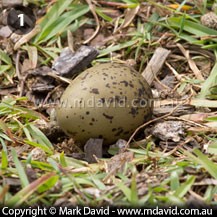
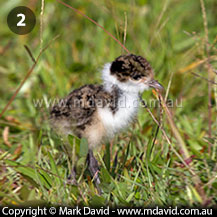
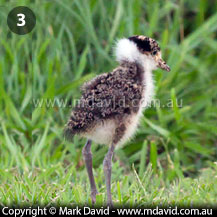
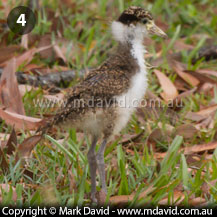
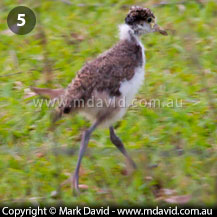
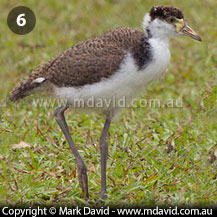
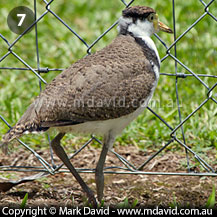
Masked Lapwing chick growing up. 1: Egg 2: one-day-old chick 3: Two weeks after hatching 4: Three weeks 5: Four weeks 6: Five weeks 7: Six and a half weeks after hatching and starting to make very short flights (getting a few inches off the ground)
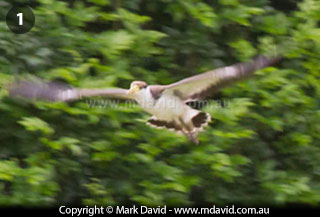
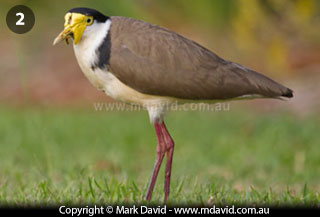
1: Eight weeks after hatching this chick was having no trouble flying 2: Mature Masked Lapwing
Over the following weeks, the chicks feed themselves under the watchful eyes of mum and dad. They face a lot of dangers from pets, predators and of course that well-known arch-enemy of flightless birds crossing roads: the car. In the evenings the family gathers itself into a more sheltered spot to settle down for the night. In the fading light this is one of the best times to see some of the more gentle and caring sides of the parents, providing a huge contrast to all the action happening earlier. You might even notice a chick or two disappearing almost completely into the warmth of a parent’s plumage as the larger bird calmly looks on.
About 6 weeks after hatching the chicks will have finally grown some proper feathers, including wing feathers. They won’t look like spotty balls of fluff on long legs any more. Instead they will take on the appearance of slightly smaller versions of the adults. Soon you will be watching the whole family take to the air at the sign of danger. The parents aren’t ready to kick the kids out just yet though. Chances are that they will stay together at least until it’s time to breed again the following year.
If you’ve got a pair of Masked Lapwings swooping you on a regular basis then you might be wondering how long it’s going to last.
The answer is, they swoop until all the young are able to fly away from danger.
That means about a month while waiting for the eggs to hatch, and then about another six or seven weeks after hatching, at which point the young have fledged and are able to fly.
Of course, once the eggs have hatched the family doesn’t hang around the nest area for long, and so you’ll generally get a bit of a reprieve when they wander around during the daylight hours to other places for feeding.
Putting up with a little bit of commotion over a couple of months is really not a big deal when the plus side is seeing Masked Lapwings in action. It’s difficult to watch their parenting without coming away with a genuine admiration for these birds.
When a pair of Lapwings chose our backyard as its nightly sheltering spot for its young family we consciously chose to give the birds a fair bit of space, and hey, we didn’t even ask them to pay rent! But the locals tell us those chicks were the first Masked Lapwings to make it to maturity in this neighbourhood in a long time. The following year the birds returned, but that time it was to lay their eggs in our yard. It was even more fun watching the birds that second time around.
Photographing birds is as much about enjoying the experience as it is about respecting the wellbeing of your subjects. Being careful not to disturb your subject is even more important when the birds are breeding.
To get the photos of the breeding birds on this page involved a bunch of tricks that ensured that they weren’t disturbed. In some instances I was using a hide. I also noticed that one of the parents was a lot less vigilant than the other in guarding the eggs, and would sometimes wander off to seek food, leaving the eggs unguarded. That offered some brief opportunities to get pictures of the nest.
Also, all of the shots were taken with my longest telephoto lens, allowing me to work from the greatest possible distance.
As much as it’s fun to get a nice shot, it’s a whole lot more enjoyable if the birds are not frightened away by your behaviour as a photographer. If it ever comes to a choice between missing out on a shot or disturbing the subjects, then I much prefer to miss out on getting the shot.
Since I wrote the article above I’ve watched the Masked Lapwings return at least a dozen more times to nest on our block. We often get more than one brood per season. And I’ve seen a lot of variation in the parent birds’ behaviour over that time.
The meticulous egg-minding described above has gradually been replaced with a more “casual” style of parenting, or at least, that’s what happened at our place. The adults birds now frequently walk off to feed for extended periods, leaving the eggs’ spotty camouflage to do all the work protecting them. Although the birds didn’t lose their enthusiasm for swooping me when I stepped outdoors.
In the most recent brood, 3 out of 4 eggs hatched and the parent birds and three chicks walked off, leaving the 4th egg behind. I watched the chick struggling to emerge from that egg but left it alone to see if the parent birds would return. Sure enough, one of them did and it seemed to help the chick out of its shell cage.
I guess the point I’m making here is that the plover parenting you witness might be different to what I described above. On average, 2 chicks from every brood here (normally 3 or 4 eggs) survive to maturity so the birds do seem to know what they are doing. I personally believe in keeping my interference to a minimum. That also means the grass gets a bit long around their nest until they are finished. But I can live with that.

Copyright © Mark David. All rights reserved