
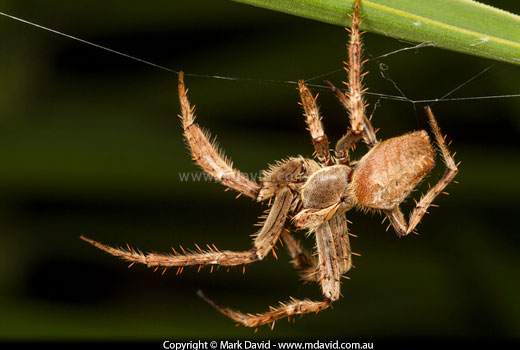
The best way to define a spider is by listing its features.
It’s an eight-legged critter that eats other critters. They don’t have a spine and so they carry their squishy bits around inside a hard armour-like skin called an exoskeleton.
Now, apart from the bit about having eight legs I could have been describing lots of insects here, so I’ll now mention some things that make them different from insects.
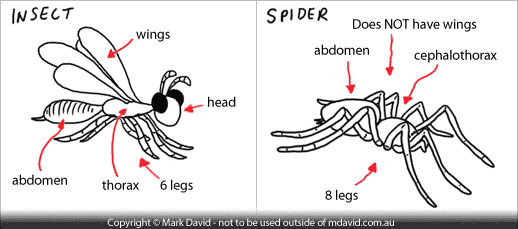
You’ll see in the cartoony pictures above that the spider doesn’t have wings. That means spiders can’t fly, although some of them do manage tricks which allow them to either glide or be carried by the wind. You’ll also see that the insect has its body divided into three main bits (head, thorax and abdomen) while the spider has only two bits. That’s because the spider’s head and thorax are combined into one section called a cephalothorax.
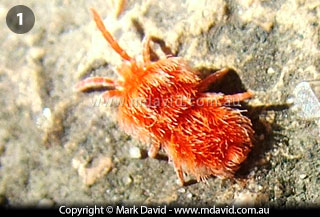
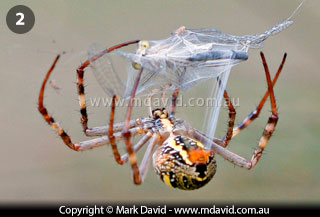
1: Not a spider: This little critter has eight legs like a spider, but it’s not a spider. My guess is it’s a Red Velvet Mite. This one was about 3 mm long. Mites are closely related to spiders 2: The damselfly has seen better days than this one, as a St Andrew’s Cross Spider wraps it in silk. In this picture you can see the web streaming out of the spider’s spinnerets.
Spiders differ from insects in having spinnerets at the end of their abdomen. The spinnerets are the little things out of which the spiders release their silk. So while other critters, like silkworms for example, can produce silk, they don’t do it from spinnerets, and they also can’t match the amazing versatility and variations in silk that a spider can manage.
Spiders are also unique among the arachnids in having venomous chelicerae.
Huh?
Okay, arachnids are the large group of critters that includes spiders, scorpions, mites and ticks. And chelicerae are the tiny appendages at the front that include the fangs.
Spiders are unique in the world of arachnids in having males equipped with special modifications to the palps which they use when they’re mating. (Palps are small appendages, like little extra legs, at the front of the spider.)
And finally, here’s another thing about spiders: they’re not able to chew their food.
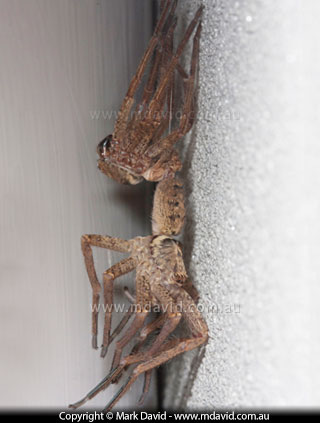
Wolf Spider emerging from its old skin
I mentioned earlier that spiders wear a tough skin called an exoskeleton to hold their soft bits together. That system works well for spiders but it has its limitations too. The exoskeleton is not able to keep expanding as the spider inside it gets bigger. So as a spider grows up it sometimes has to produce another skin and shed the old one. The picture here shows a Wolf Spider emerging from its old skin.
I already mentioned that spiders have fangs which can inject venom. Despite that fact, most spiders are not dangerous to people. However, because some spiders can be dangerous I advise people to treat all spiders with caution, especially if you have trouble knowing which ones are the most venomous. Also, many types of spider could be carrying some pretty bad types of bacteria on their fangs, that could cause a painful skin disease called necrosis. So even if a spider isn’t particularly venomous, it’s always better to avoid a bite.
You might have noticed that I said that spiders inject venom from their fangs. That’s why spiders are described as venomous instead of poisonous.
Now I could get into a bit of trouble here because this subject is complicated, but a rough guide goes something like this: something is considered poisonous if it’s dangerous to eat it or breathe it. For example, many types of wild mushrooms are poisonous.
And a critter is considered venomous if it puts venom into you by either biting or stinging.
This article draws on a heap of stuff I learned so long ago that I wouldn’t be able to remember the sources but I did add to it using some stuff I learned from the following really good book:
A Guide to the Spiders of Australia
by Volker W. Framenau, Barbara C. Baehr and Paul Zborowski
Reed New Holland Publishers Pty Ltd, 2014.
It’s a fantastic book which I’d recommend to anyone who’s seriously interested in Aussie spiders.

Copyright © Mark David. All rights reserved


