
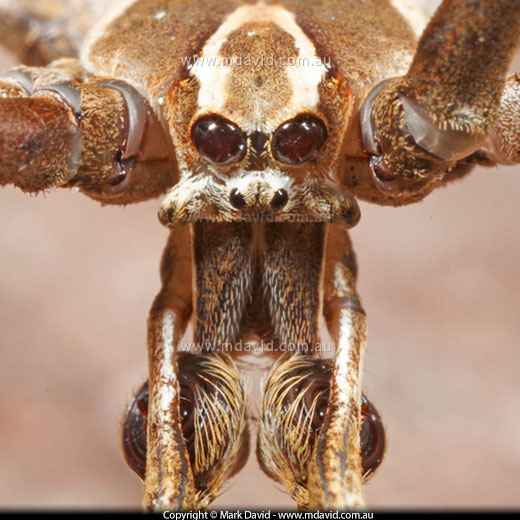
Seen up close, it’s easy to understand why Deinopis spiders are sometimes called ‘Ogre-faced Spiders’
If you live in Sydney there’s a good chance you’ve seen plenty of these spiders — you just might not have realised it! They have excellent camouflage, making them resemble scraps of dead twigs and leaves.
You don’t even have to live in the leafy suburbs. All the photos on this page, for example, were taken in the courtyard of an inner city terrace.
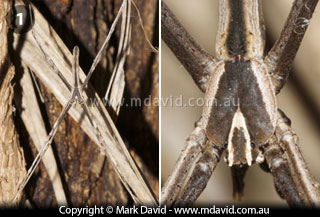
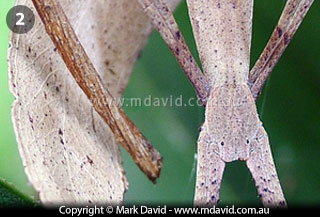
1: A Deinopis spider photographed in the inner-eastern suburbs of Sydney, and a close-up detail of the same spider. Before you examine these spiders up close you could easily mistake them for twigs. 2: This Deinopis is coloured almost exactly the same as the dead leaf beside it.
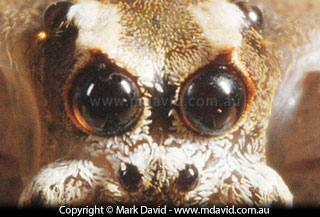
The huge pair of eyes on the front of a Deinopis spider’s “face”
Those big eyes that dominate the front-on view of these spiders are big for a reason — they are able to collect very faint light at night so the spider can see its prey. But to make matters more interesting, they destroy the light-sensitive membrane inside those eyes at dawn and regenerate it at night, to maintain their super-sensitive night vision.
At night time, Deinopis builds a special kind of stretchy net and hangs upside-down holding it with its front legs. It does this just above a surface where an insect might walk, then patiently waits for a meal. Once something wanders within range the spider stretches the net out with its legs and in one quick action, wraps it over the prey. The prey is immediately overwhelmed.
Because this all happens at night, these spiders need superb eyesight, capable of seeing movement in the dark. And that explains the huge eyes.
In the daytime, they usually don’t have a net with them and so they just hang around motionless, looking like some dead twigs.
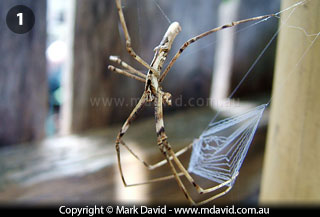
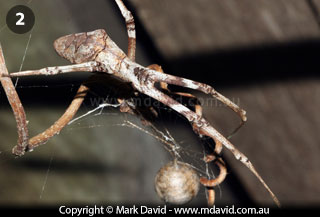
1: Deinopis with its net. 2: This picture shows a Deinopis with its egg sac. This was in the middle of winter, representing a nice picture subject at a time of the year when there weren’t many critters around.
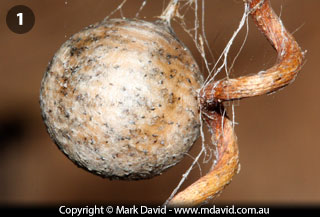
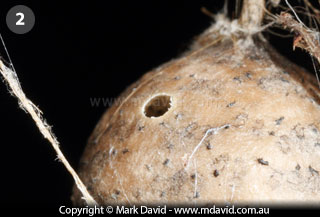
1: Like the spiders, their egg sacs are nicely camouflaged. 2: The following summer, a small hole appeared in the egg sac. The adult spider had long since disappeared.
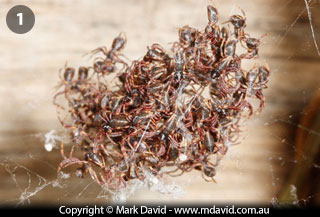
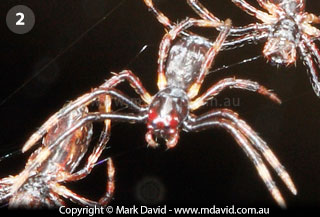
1: After leaving the egg sac, the spiderlings cluster together some place nearby. This entire cluster is about an inch and a half long, which should give you an idea of how tiny the spiderlings are. 2: Here’s a close-up shot of the spiderlings. Note the distinctive Deinopis pose with the front legs kept together.
A Guide to the Spiders of Australia
Volker W. Framenau, Barbara C. Baehr and Paul Zborowski
2014, Reed New Holland Publishers Pty Ltd

Copyright © Mark David. All rights reserved