
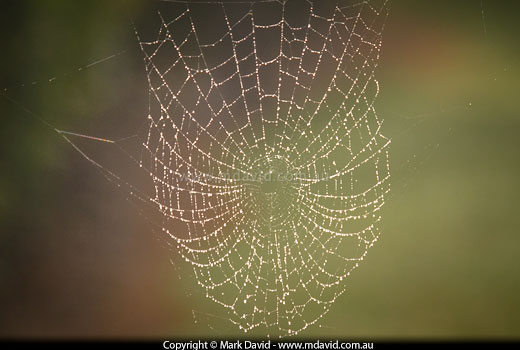
A heavy dew and some sunlight reveal the typical wheel-like structure of an orb web.
An orb weaver includes any spider that makes an orb web, and orb webs are those round webs built on a radiating structure of spokes like a bicycle wheel, like the one in the photo above. Some orb webs can be very big and strong. The gigantic Nephila spiders in Northern Australia for example, have orb webs so big and strong that they can spring you backwards until you push through them. Other orb webs can be so fragile and tiny that they’re difficult to see.
By the way, if you do walk into a large orb web then a good thing to do is to carefully retrace your steps (backwards) and then most of the web should peel right back off you. Yeah I know, that’s easier said than done, because if you’re anything like me the first temptation is to jump and thrash around a bit. So I’ll point out something that might be encouraging to all you jumpers and thrashers: I don’t know of any orb weaving spider that is considered dangerous to people, even though some of the bigger ones can cause a painful bite. And when you think about it, why would orb weavers need powerful venom anyway? Because their webs do such a brilliant job at catching and immobilising prey.
Here are some of the more common orb-weaving spiders from the east coast of Australia.
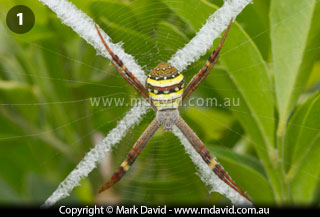

1: St Andrew’s Cross Spider with an especially large and clear cross pattern in the centre of its web. 2: The males are much smaller than the females.
What’s not to love about the St Andrew’s Cross spider? It’s colourful, harmless and eats the things that bother us. If you’re lucky you’ll find one with a clear diagonal cross in the centre of the web like the one in first photo here. That gives a clue as to how this spider got its name, because the white diagonal cross in the Union Jack just happens to be St Andrew’s Cross from the flag of Scotland.
This decorative spider hangs head-downwards in the middle of its web, with its legs stretched out over the cross. The ones you’ll see are most probably females because the males are smaller and harder to find. Look around the edges of the web and you might see a male. It has a similar shape to the female but is smaller and less colourful.
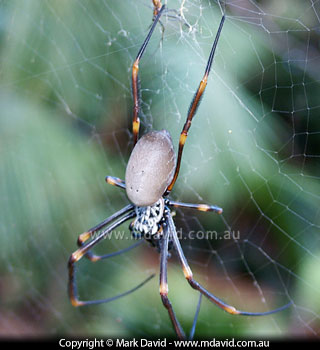
Nephila plumipes (used to be called Nephila ornata)
Here’s another common spider around Sydney, especially around late summer and early Autumn when you might find lots of them hanging around places like power lines and trees. The photo here should help you recognise it. I could easily fill a page just with these spiders, so I did.
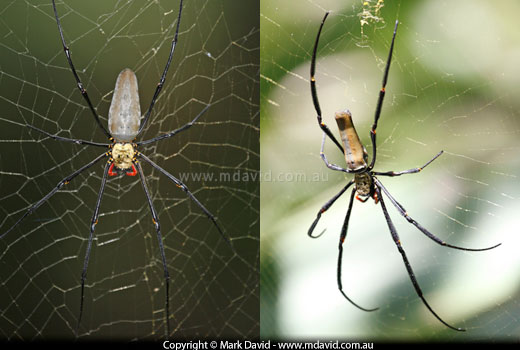
There are other spiders in this group. It’s pretty safe to call them Golden Orb Weavers.
In northern Australia they can get pretty big. The spiders shown above, for example, were both about the size of my outstretched hand.
Living in the tropical north of Australia, these handsome critters make very strong — and big — orb webs. Their web is so strong that some indigenous people have found some clever uses for them. For example, they might swing a stick through their webs, tangling up the spiders and their webs, and use those spidery tangles to lure and trap fish.
These spiders eat insects that get caught in the web, and I’ve seen pictures of them eating birds too. With a web so big (over a metre across) and strong it’s not surprising that could sometimes happen — very occasionally — but I stress that birds are not their usual diet.
I often smile at Hollywood movies which all too often feature Nephila spiders in one of their jungle scenes. We’re obviously supposed to think the 8-legged beastie hanging in its web is a bad thing, but like I said earlier, the truth is they are not dangerous to people at all.
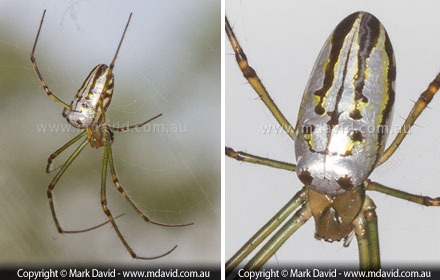
Leucauge granulata
These guys look like miniature versions of the Nephila spiders (see above) except they have the bold pattern on their abdomens. About the size of an Aussie 20 cent coin, they produce an orb web that is not nearly as robust as those from the Nephila spiders.
Look for those yellow and black patterns on the abdomen, and if you look really close you might also see the green colouring in the legs.
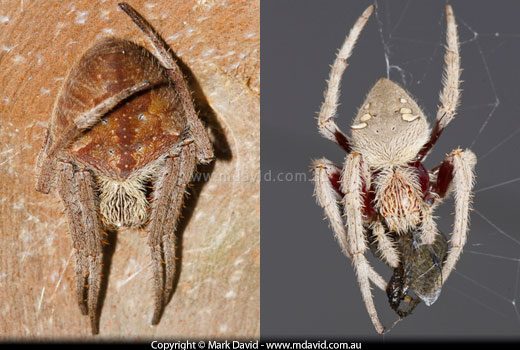
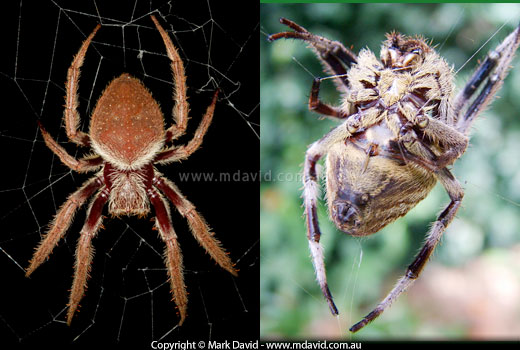
If you walk out your front door in the morning and get a face full of giant orb web that wasn’t there the day before, then chances are you’ve got a Garden Orb Weaver. This is a common spider — actually a common group of similar spiders from different species — and people with the above-mentioned face-full of web might argue they’re a little too common. I’ve lost count of the number of encounters I’ve had with these webs and will happily admit I have yet to enjoy the experience, yet I still love seeing these spiders around.
Garden Orb Weavers, or as some prefer to call them, Garden Spiders, make a new web each night, more often than not where you least expect it. They hang around in it until the morning when they’ll climb up to hide under a leaf or some other shelter like the eaves of your house. If you find their big empty web during the day you can usually locate the spider by looking for convenient hiding spots above their web and near where one of the support strands is attached. The spider will be hunched up trying not to be seen.
These spiders are big, heavy-bodied, hairy, and harmless, although being such big brutes, a bite from one can sometimes hurt. They are mostly grey or brown but can also be orange, black and white or grey. Because they make a new web each night, you can get a good chance to watch how they make them.
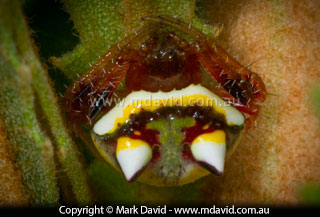

Poecilopachys bispinosa
I enjoy finding these ones. They have a small horizontal orb web which they build at night and then destroy (and eat) the next morning. Their abdomen is adorned with two very conspicuous spines. Watching these under high magnification is amazing and just a little bit creepy, because those bold patterns and spots actually move! Yep, strange but true.
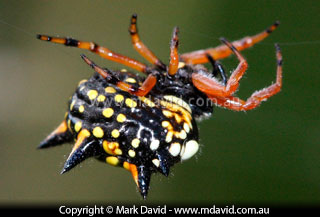
Another strange but also beautiful spider. The abdomen is large and has those prominent spines, which certainly explains the name. The rest of the abdomen is decorated with spots and stripes. These ones were photographed in the Southern Highlands district of NSW but they will turn up in each of the states of Australia.
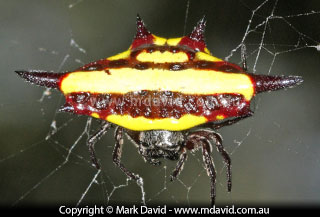
If you thought the previous two spiders were odd, then have a good look at these ones. You’ll see them in the centre of their webs, and there are lots of them in northern Queensland.
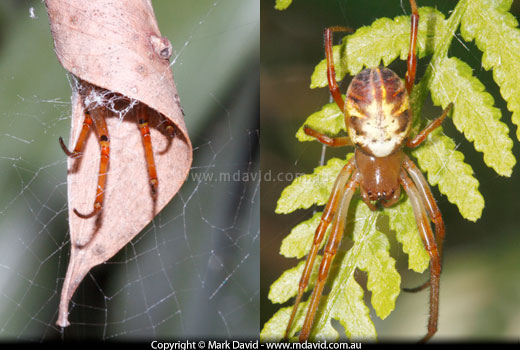
Leaf-curling Spider in its leaf (left), and a better view of the spider (right)
The Leaf-curling spider is an easy one to identify, even though it’s often hard to see the spider, so I’ll include two pictures with this section. If you see an orb web — about a foot across, with a leaf curled around in its centre and only a few spider legs visible inside the leaf, then you’ve got a Leaf-curling spider.
This spider uses its silk to hold the leaf in a curled-over shape as a place to hide, only racing out when the web catches something. For some strange reason, whenever I feed these spiders with an insect or something (hey, we all need hobbies) the spiders always seem to muck things up. They charge out, run around in a big flap towards everything except the insect and the insect invariably escapes. Behaviour like that makes me wonder how they’ve lasted this long. But clearly they have lasted this long so I guess they know what they’re doing. Sometimes.

Copyright © Mark David. All rights reserved | Mark David on Google+


