
Nature Stuff mdavid.com.au

Glossy Black Cockatoos

The Glossy Black Cockatoo (Calyptorhynchus lathami) is a handsome bird that might not be around too much longer. As long as we keep clearing its habitat we push it closer to extinction. But as is so often the case, we can still do something about it.

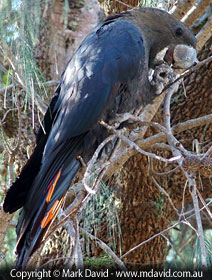
Glossy Black Cockatoo

When a flock of Sulphur-crested Cockatoos moves into your neighbourhood you tend to know about it. Their screeching call is outrageous. Glossy Blacks however, sit calmly in their Casuarina (Sheoak) trees cracking seeds open, mostly unnoticed. That’s the clue to finding them. Countless times I’ve been in the bush and heard what sounds like someone busy working with a nut cracker nearby. Find the source of the sound in the nearest stand of Casuarina and look up and chances are you’ll see a pair of Glossy Blacks. When I say ‘countless times’ it’s probably the same pair of birds I’ve seen on most of those occasions, because a pair will often settle into an area once they find a good source of food trees.

What do they look like?

This is the smallest of the black cockatoos, which is saying something about just how big the other ones are, because this is still a decent-sized bird (approx. 48cm). First impression is black wings and almost black body, with a flash of red in the male’s tail. The female looks similar but has an irregular yellow blotchy band around its neck and some yellow in the tail. They look a lot like the red-tailed black cockatoo but don’t have a big crest on their head. A familiar stance is one foot holding the branch with the other foot holding the seed. The photos on this page shows this.
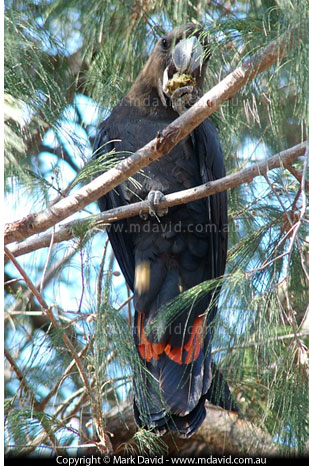
Glossy Black Cockatoo

Where do you find them?

You’re most likely to find them in Casuarinas or sometimes gum trees in eastern Australia, from Southern Queensland extending down into Victoria. There are also a few on Kangaroo Island, off South Australia. If you’re in the bush and come across a stand of Casuarinas where the ground underneath is thoroughly covered with cracked seeds, there’s a good chance you’ve found a place where a pair of Glossy Blacks feed.

Why are they threatened?

These birds rely on Casuarina for the bulk of their food, and Casuarina tends not to be considered a valuable tree by many people. Casuarinas burn badly in a bush fire, and this makes Glossy Blacks susceptible to fires too. They like to nest in tree hollows near their food trees, which is a problem because good hollows are becoming more and more rare, as land clearing for housing removes old gum trees and breaks the bush up into isolated patches, which separates the nesting trees from the food trees. Also the declining number of tree hollows is already in great demand by other species.

What can we do to help?

The first thing is to allow stands of Casuarinas to grow. Also, old gum trees with hollows are extremely important nesting spots for Glossy Blacks and heaps of other native species, so we could value them a lot more too. Even dead trees, if they have decent hollows, are important nesting spots.

People need nature more than nature needs people
Nature Stuff

So what’s with this Nature Stuff then?

Birds

Indian Mynas
Pushy and invasive

Noisy Miners
Aggression in the suburbs

Noisy Miners, Indian Mynas
Here’s how to tell the difference

Starlings
Another feral pest, or not?

Australian White Ibis
Conservation takes a twist

Common water birds around Sydney

Masked Lawpings
Or should we be calling them Spur-winged Plovers?

Pacific Black Ducks
A common Aussie duck

Geese teeth
No seriously, do birds have teeth?

Birds’ knees
Do they bend forwards or backwards?

Rainbow Lorikeets
Raucous and colourful

Sulphur-crested Cockatoos
Beautiful birds with an awful call

Yellow-tailed Black Cockatoos
Beautiful birds with a beautiful call

Glossy Black Cockatoos
Casuarinas’ seed crackers

Are they Crows or Ravens in Sydney?
Here’s your answer.

Black Swans
Bird emblem of Western Australia

Brush Turkeys
Cool birds, huge nests

Darters
Comfortable on land, in the air and water

Australian Pelicans
An impressive large water bird

Black and white birds
Identifying from a bunch that is easily confused

The Australian Magpie
Buddies in the back yard


Reptiles

Lizard bite
Getting more than you bargained for

Asian House Geckos
More than just a pretty face?


Plants

Lantana
Tough, invasive and widespread

A few big Australian trees
Some examples I’ve seen in my travels

Unusual and beautiful Australian trees
Some more lovely trees

Why Australia’s giant trees might never return
Perhaps we shouldn’t take them for granted.

Insects and spiders

One of the longest insects in the world
(Including photos of course)

Jumper Ants and Bulldog Ants
Insects with attitude

Some common Australian orb-weaving spiders
A basic guide to their identification.

Hunstman Spiders
A spider with an undeserved bad reputation

Fear of Huntsman Spiders
How I dealt with it

Golden Orb Weaver Spiders
A common large spider

How many eyes do spiders have?
Here’s your answer (and photos).

newHow long do spiders live?
They can’t last forever.

How many eyes do insects have?
The answer might surprise you.

How I catch spiders
(to take them outside)

The amazing net-casting spiders
A bit of a favourite spider of mine.

Commensal spiders
Eating the leftovers

What is a spider?
No, seriously, what makes a spider a spider?

Jumping spiders
Cute and often colourful


Nature words

So what’s a feral species, really?
Here’s the real answer.

What’s the real meaning of the word ‘bug’?
Another one of those words with a very specific meaning.

Venomous or poisonous
What’s the difference?


Other stuff

From Cane Toads to tree frogs
It was rewarding in ways we didn’t expect

Book review
Back from the Brink

Camouflaged critters
Blending in to a scene near you

Critters in the city
Blending in to a metropolis near you

Fire and the Australian bush
A brief look at a complicated story

Cute stuff
Critters sure can look cute when they’re little

Feeding wild animals
Is it always a good idea?

Photo Sales
I might have that Australian nature pic you’re looking for

The Latest Pics
Archive of my latest nature photos


Copyright © Mark David. All rights reserved