
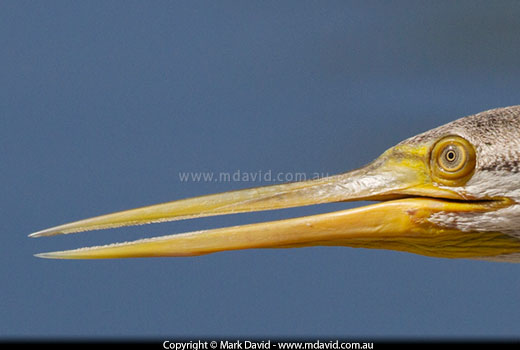
The Darter (Anhinga melanogaster) uses its sharp beak to spear fish.
A walk past one of the large ponds in Sydney’s Centennial Park will usually involve seeing some Darters. However that is thankfully not the limit of their range in Australia. Darters exist throughout most of the country.
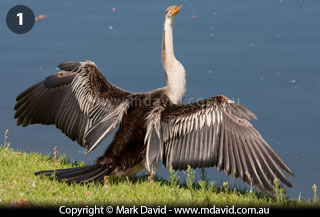
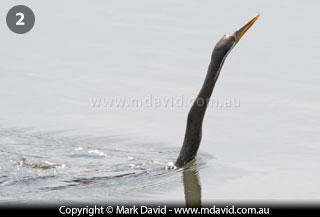
1: A Darter stands with its wings outstretched, drying its feathers in the sun. 2: Darters can resemble a snake when they swim with only their neck out of the water.
These birds are unusual for a water bird in that they don’t have water-repellant feathers. While that might sound kind of stupid for a bird that spends its life near or in the water, it actually makes a lot of sense, because it allows the bird to dive underwater without the unwanted buoyancy that a regular bird would have. This saves it from wasting lots of energy getting to the bottom of a pond where all the best fish are.
So that’s the good part of lacking water-repellant feathers. The bad part is that, after some time underwater, the bird’s feathers are completely soaked and so it will need to dry them out. Otherwise it will waste too much energy flying.
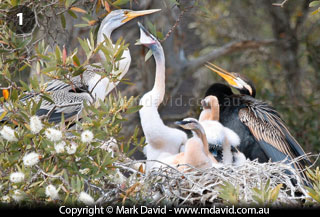
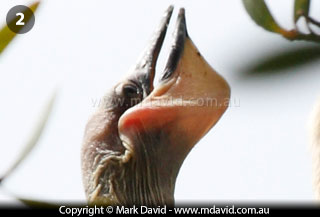
1: A family of Darters in a nest. The adult male is the one with the all-over dark plumage. 2: Darter chick
So the Darter will find a nice sunny place and stand with its wings outstretched, drying its feathers.
Darters are sometimes called snake birds and it’s easy to understand why when you see one in the water. They often swim partly-submerged with just that slim head and neck above the surface. Seen from a distance these birds really can look like snakes when they do that.
I was careful when I took the photos of the chicks in their nest. That’s because the parents in many bird species become especially nervous during breeding time, and sometimes having a human wander nearby can frighten the parents into abandoning their brood altogether. So when you approach any type of nesting birds it’s essential to watch the parent birds to see if their behavior changes as you approach. For example, do they spend more time away from the nest than normal? While taking these photos, the parents were in the nest and they were not even looking at me, which I took to be a good sign.
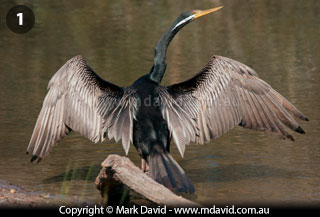
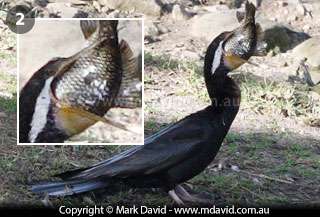
1: The black body and neck show that this Darter is a mature male 2: Darter swallowing a large fish. A puncture hole in the fish can be seen in the inset.
The photo of the family group was taken from across a lake using a telescopic lens. The same telescopic lens was used in the photo of the chick, and it was taken from the cover of some trees. Even though you sometimes see people on TV posing right alongside chicks in nests that is something I won’t do. It’s more important for me to ensure the birds are happy not being stressed, and the chicks well looked after, than it is to get that perfect shot.
Mature male darters have more dark plumage than females and the young ones. It’s the male which builds a nest. The nest is assembled in a tree alongside water and both sexes play their part in looking after the eggs and young.
Darters mainly eat fish although they’ll also eat other small critters from the water such as insects. I’ve read about them catching fish by spearing them with their long, sharp beak. Although I haven’t personally seen them doing that the fish caught by the Darter in the picture above clearly has a hole in its side which suggests it’s been speared. And yes, in case you’re wondering, it did manage to swallow that fish whole.
Reader’s Digest Complete Book of Australian Birds
Reader’s Digest Services Pty Ltd, 1979


Copyright © Mark David. All rights reserved


