
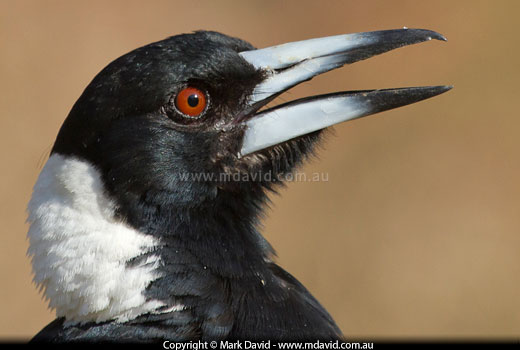
Magpies are one of those birds which, in my opinion always appear to be bigger than you expect. Yeah, I know, that’s not much help to you. But a healthy mature magpie can reach an imposing 44 cm length from the tip of its bill to the end of its tail. Perhaps it’s the calm, assertive poise of a dominant male magpie which makes it appear bigger.
A healthy mature specimen will have glossy black and white feathers. Its beak will be pale but with a dark point. Immature magpies have a ruffled look about them, with plumage more mottled grey/brown and black and white than just black and white. The photos on this page should give a good idea although keep in mind that there is another ‘race’ of Australian Magpie which has much more white running down its back.
Throughout most of Australia. They form part of the landscape of countless parks and suburban back yards.
Australian Magpies usually hang around in a group. It might just be a pair or a small family, but numbers in some groups can reach 20 or more. Groups of birds will defend their territory from other groups, and will often burst into song (called carolling) after successfully defending their turf.
With some birds, like Brush Turkeys, nest building is done by the male. But with the Australian Magpie, the nests are built by females. Nests are built in trees and made of twigs and other plant matter, then lined with bark or other softer materials. Up to 5 eggs are laid.
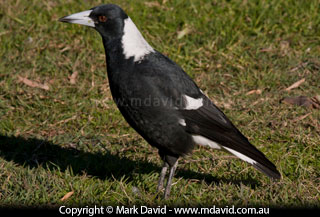
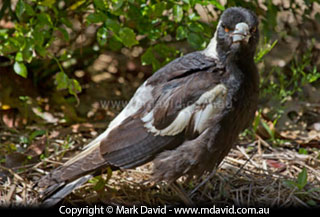
Mature Australian Magpies are black and white. Young ones like the bird shown in the second photo reveal their age by having a ruffled, mottled grey/brown and white appearance
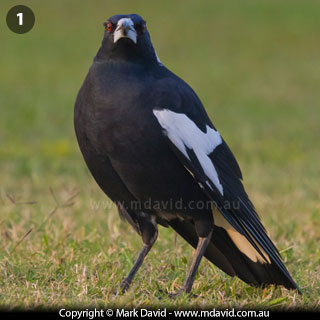
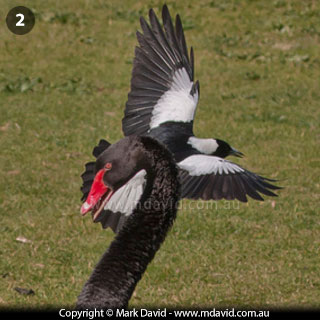
1: The imposing stance of a healthy mature Australian Magpie as it studies me, probably making up its mind about whether I’m dangerous. 2: Despite the fact that the Black Swan was no threat to the magpie or its young, this magpie repeatedly swooped and harassed the swan until the larger bird left the area.
When magpies are breeding you might hear stories about (or experience personally) an example of a magpie swooping at people. I’ve seen this happen myself although that kind of behaviour is not normal for them. There are a bunch of theories around to explain their swooping. Some people suggest the birds are just showing off at a time when the male birds want to look their best and toughest in the eyes of the females. Some suggest the birds are swooping at people who fail to respond to early warning signals from the birds to stay away from their young. Others suggest the birds might have developed a bit of bad attitude to humans as a result of humans treating them badly when they were young.
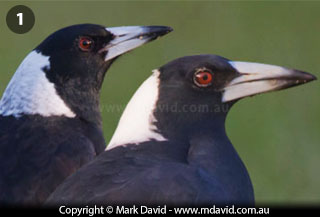
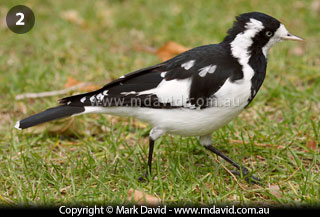
1: Female magpies have a dappling of grey-tinged feathers on the base of the back of their neck. The male bird is in the foreground. 2: The Australian Magpie Lark is sometimes mistaken for an Australian Magpie. The Magpie Lark, however, is much smaller and lacks the black tip on its bill.
To complicate matters, swooping isn’t always directed at creatures that pose a threat to their young. I once watched a Magpie constantly swooping a Black Swan, which kind of annoyed the swan. Since Black Swans are herbivorous they would not pose a threat to the Magpies.
The thing is, when Magpies are breeding, the males experience a huge surge in hormones. Perhaps think of a swooping Magpie as going through something like a bit of ‘roid rage’. So you have your highly-strung bird, full of hormones and not coping too well with the responsibility of looking after its young. And then someone pedals right through the middle of its territory on a bicycle.
So, whatever the reason, allow yourself to be reassured that the swooping behaviour will most likely ease off once the young have matured a bit. It shouldn’t last longer than perhaps a few weeks.
I’ve read about some magpies that will keep on attacking forever but those birds are mighty rare.
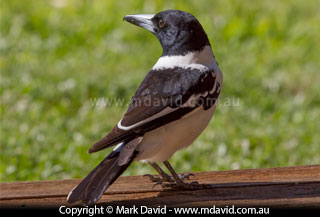
The Pied Butcherbird is another bird easily confused with the Australian Magpie. Compared with the Magpie, the Pied Butcherbird is a slightly smaller bird with a much more noticeably hooked beak.
Magpies spend a lot of time defending their territories. The place where I live, for example, sits right on the border between the territories of two groups of Magpies, with one group claiming rights over one side of the lawn and the other group claiming the other side. I have never seen the birds cross sides. In this type of situation, a large group of birds will have a big advantage in defending their turf over a small one, and so some people think this is a reason why they hang around in groups. I’ve enjoyed watching the birds from a distance and allowing them to watch me, to let them get used to the idea that I’m also part of their territory but not a threat to any of them.
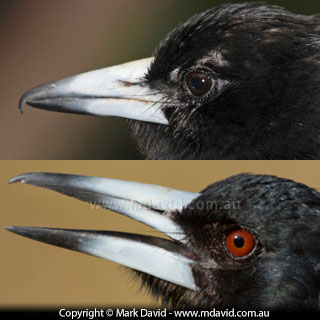
These two photos compare the sharply hooked beak of the Pied Butcherbird (top) with the Australian Magpie (below).
The birds seem to accept me up to a point but have no tolerance for the other groups invading their territory. Standoffs at the border sometimes occur with lots of carolling and occasionally swooping and chasing. But all that stuff never lasts for long and the birds on both sides invariably end up peacefully walking the lawn looking for food again.
Magpies like to feed by walking along the ground in their group, picking up things like worms, insects, spiders and small frogs.
A bit of swooping by a minority of Magpies over a small amount of time is a tiny price to pay for having these fantastic birds around. They are handsome, intelligent and inquisitive birds and most of them are gentle and calm creatures. And chances are, most of the things they feed on are the things you probably don’t want to have around anyway. Watching a family of these birds quietly roaming their territory is a delightful way to calm down after a day spent fighting for parking spaces and trying to be polite to telemarketers. They (the Magpies, not the telemarketers) are some of my favourite creatures.
And apart from all that, these birds are part of our environment and we need our environment to survive. As long as the magpies are around, I figure I’m seeing things the way they’re meant to be.
Field Guide to the Birds of Australia
7th Edition. Ken Simpson and Nicolas Day
Published by Viking (Penguin Group) 2004
Australian Magpie: biology and behaviour of an unusual songbird
Gisela Kaplan
CSIRO Publishing 2004
Reader’s Digest Complete Book of Australian Birds
Reader’s Digest Services Pty Ltd 1976
Copyright © Mark David. All rights reserved