
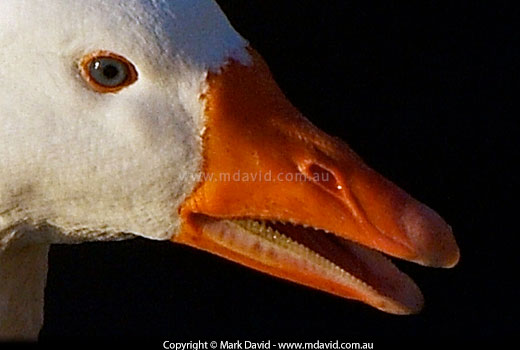
I should be careful in my choice of words now. The goose beak might be “toothed” but those things aren’t really “teeth”.
The “teeth” you see in the photo above aren’t the same as the things you and I carry around in our gums. Unlike lizards and mammals, somewhere during their evolution birds lost the ability to produce enamel. Enamel is the tough white stuff that coats our teeth and which makes them so hard. So those goose teeth won’t be as hard as your own but they would still come in handy cutting through things like grass. They would also let the goose get a better grip on slippery things like snails. What this photo shows is a row of sharp points, or serrations, inside the beak. Scientists have a word to describe those serrated birds’ “teeth”. They call them tomia.
Yes they did, if you look far enough back in the fossil records. During the Mesozoic era there were birds with teeth in both jaws. This starts to make sense when you remember that birds and modern reptiles seem to have evolved from the same toothy ancestors. So there was a time when both groups had teeth.
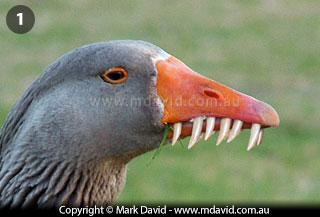
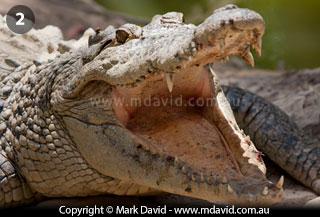
1: Photoshop makes this just too easy. So okay, I’ll be really clear about this: this image is a digitally-manipulated FAKE! 2: But there’s no doubting the authenticity of these chompers. Crocodiles have retained the ability to make tooth enamel.
This is a tricky question to answer. There aren’t very many high-quality fossils of birds. Birds have thin, hollow bones and feathers which don’t fossilize well. So scientists have to piece together their stories of ancient birds without much information. During the time that birds lost their teeth they developed all sorts of specialised beaks suited to their various diets and the beaks do the job that the lips and teeth once did. So I won’t try to answer the question of why birds lost their teeth. I’ll just have to say that they did.
Copyright © Mark David. All rights reserved