
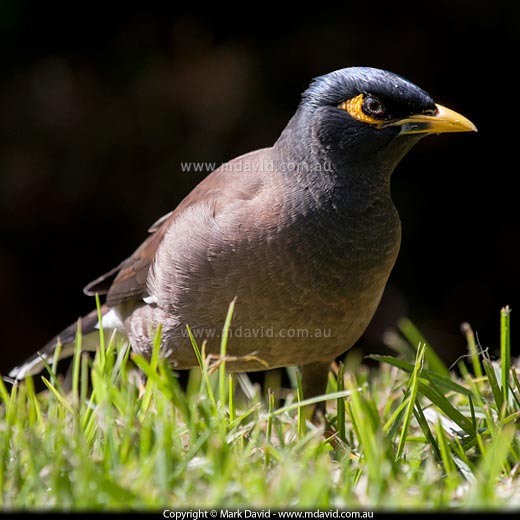
These little brown critters might look harmless but the World Conservation Union takes them very seriously. They put them in the list of the 100 most invading species in the world and describe them as an extreme threat to Australia. And humans don’t get off easily either. Mynas carry bird mites and have the potential to carry avian-borne diseases that are dangerous to people, not to mention the huge amount of droppings they leave under their communal roosting trees. Often gathering at night in numbers in excess of a thousand, these raucous birds can take over clumps of trees, especially around areas where lots of people go (where they encounter fewer predators) like shopping centres. In a short time their droppings can cover 100% of the ground and public seating under the trees. I speak from personal experience when I say you don’t want to park your car underneath them.
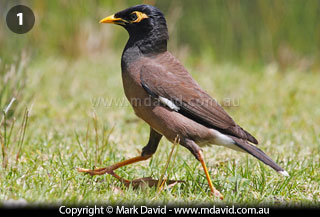

1: The Indian Myna is easily recognised by its black head and neck and chocolate-brown body 2: Noisy Miner. Some people mistake this indigenous bird with the introduced Indian Myna
Indian Mynas are easy to recognise. They’re about 25 cm tall and mainly chocolate brown, with a black head and neck, and a yellow beak. Some people confuse them with the Noisy Miner, an indigenous Australian species about the same size. The noisy miner is a honey eater indigenous to Australia, while the Indian Myna is part of the starling family and comes from India. The photos above should help you tell them apart (and if those photos aren’t enough then I have a whole page about the differences between them here.)
I’ve seen Indian Mynas swooping aggressively at other species of birds although most of the time they appear to behave peacefully. Most displays of Indian Myna aggression I have watched were directed at other Indian Mynas. The Noisy Miner (an Australian species shown above) is much more likely to be the one seen swooping and charging at other birds, or even at cats, dogs or people! However it seems that the usually-pleasant nature of Indian Mynas changes when it comes time to move into a nest for breeding. The excellent Birds in Backyards website describes ‘violent battles’ staged by Indian Mynas evicting the birds that already occupy a nest. This is a common theme in literature about them. And in the fascinating book the new nature, author Tim Low mentions Indian Mynas piling straw right over the top of baby parrots.
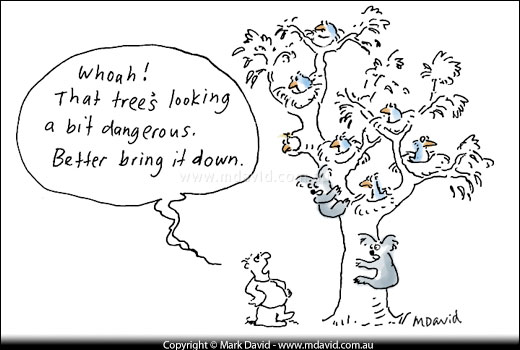
At first glance, it seems that the problem is that there aren’t enough good nesting spots to go around, and the numbers of good nesting spots are diminishing in and around towns. Where big old trees dropped branches the resulting hollow left in the trunks provided excellent nesting spots for birds. It’s not surprising that old trees in towns are chopped down or pruned before they drop branches because a falling branch can be extremely dangerous.
Again refering to the new nature, author Tim Low described a study based in Canberra’s bushland parks to see which species were using the nesting boxes that had been put up. It turned out that Indian Mynas had taken over thirty five, starlings five, feral honeybees seven and native rosellas just seventeen. So the way I see it, it seems that putting in nesting boxes just lets the Indian Mynas breed even faster until once again, there aren’t enough nesting spots to go around. Apparently, if you want to put in a nesting box then you have to be extremely vigilant to keep the Mynas out.
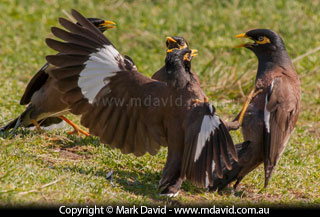
Indian Mynas fighting in a Sydney park
The amazing thing is that these pushy little critters were put here deliberately, just like the fox and rabbit (which probably take the role as being the worst introduced species in Australia). In the 1880s there was a locust plague so Indian Mynas were brought in to control them. Of course the Mynas didn’t stop the locusts but became another pest themselves. So it’s surprising that, some decades later when the sugar industry was thinking about introducing some toads to control the Cane Beetle, they didn’t stop to reflect on that earlier, failed venture. Instead they assumed that yet another aggressive introduced critter dropped into the delicate Australian ecology would solve everything.
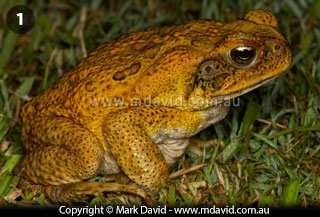
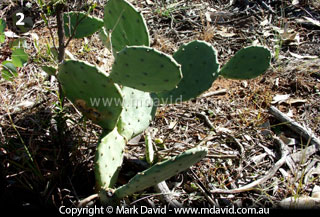
1: Cane Toad 2: Prickly Pear
The sugar industry went ahead and released Cane Toads into Queensland. Did the Cane Toads stop the cane beetle? No way. The problem was that the Cane Toads couldn’t jump even remotely high enough to reach where the beetles sat at the top of the cane plants. Instead they walked off and began spreading and spreading and spreading through Northern Australia eating pretty much everything (except Cane Beetles). So getting back to the subject of this web page, after the dismal failure with the Cane Toad, Indian Mynas were let loose there too, bringing forward the Myna problems in that state.
In 1925 Australia was in the middle of a crisis with the Prickly Pear — yet another invasive imported species. The plant had infested more than 25 million hectares and was spreading at a rate of half a million hectares per year. Pesticides and mechanical clearing were shown to be ineffective, so scientists started doing tests with a little caterpillar called cactoblastis. They knew it ate Prickly Pear, but they wanted to make sure it wasn’t going to eat everything else.
After lots of testing the little cactoblastis caterpillar was considered safe enough to let loose onto the Australian environment. So they released lots of them on a bunch of Prickly Pear infestations. The cactoblastis spread through the bush, munching their way through Prickly Pear at an amazing rate. They didn’t wipe out every last bit of Prickly Pear, but they did weaken it to the point where it no longer threatened to take over.
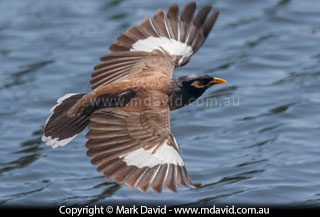
Indian Myna in flight
The cactoblastis campaign against Prickly Pear is now considered one of the most successful biological control campaigns in the world. The trouble is, in one way it was perhaps a little too successful. Because it received so much publicity for its great work, everyone heard about it and assumed that all you had to do to control a pest was just release another species to eat it. People didn’t understand how much work had been done by the scientists to check that cactoblastis wasn’t going to cause more damage than good.
So now, it seems everyone thinks they’re an expert in things as complex as ecology. The cactoblastis campaign to control Prickly Pear is one example where, by doing things properly, biological control can be very helpful, but stories like the Cane Toad and Indian Myna show how important it is to leave biological control to the scientists, even if it takes a little longer. The benefits will still be there at the end, and we might be able to avoid disasters like the releases of foxes, rabbits, cane toads and Indian Mynas in Australia.

Copyright © Mark David. All rights reserved