
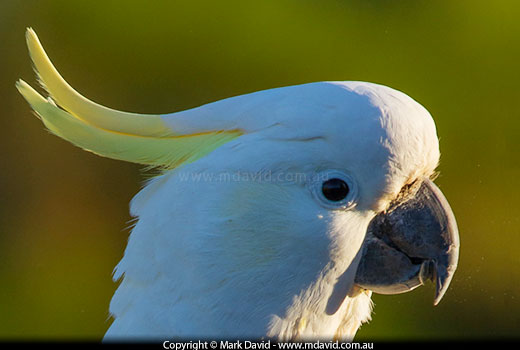
These birds have a call that can best be described as an extremely loud screech. Am I being a bit rough on them here? Ummm … no. We’re talking about a bird call about as melodic as sheet metal being dragged across a bitumen road. But I’m not complaining. They’re an amazing bird.
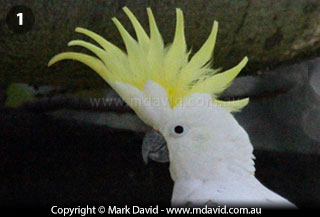
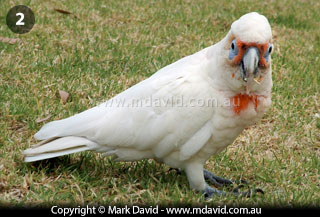
1: Sulphur-crested Cockatoo with its crest fully raised 2: Corellas look like cockatoos but lack the large crests.
They’re pretty big, measuring 45 cm (18 in). They’re mostly white, with a dark grey (or black) beak, yellow crest feathers on their head (which they sometimes stand straight up) and some yellow under the wings. Some people confuse them with corellas, which look similar but lack the big crest. To give you a better idea of the difference, one of the pictures above shows a corella.
Sulphur-crested Cockatoos make good pets but because they can live more than 65 years, adopting one of these creatures is literally a life-long commitment. Perhaps that’s why some people set them free. But then, setting pets free can be a real problem. Not only can it be cruel for the pets, which might not know how to fend for themselves, but it can disturb the balance for the wild animals in the area. They were probably freed or escaped cockatoos which started the wild flock around Perth.
As pets they will often bond with just one person, while being aggressive to others. They’re really smart birds, and can be trained to mimic speech. But being smart means that if you keep them as a pet, then you must make sure they don’t get bored. So they need plenty of toys to chew on.
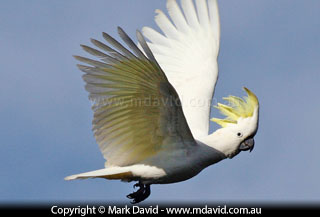
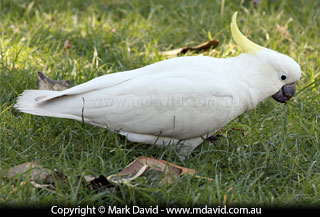
Sulphur-crested Cockatoos, in flight and feeding on the ground
When I see wild Sulphur-crested cockatoos they’re often playing with something like seed pods or even aluminium cans. I once saw a bunch of them use a can to play a kind of bird version of football.
Seeds, berries, nuts, roots. They have an immensely powerful beak strong enough to cut through small branches, but they don’t eat the branches — they look to me like they’re doing it more out of fun! People who feed them bird seed from their balconies often come to regret it later because they will return in ever-increasing numbers, often chewing up the timberwork on balconies or window sills while waiting to be fed. These birds are natural pruners of native plants. You might be happy to have your grevilleas cut back, but not the expensive cedar woodwork on your house.
I remember seeing flocks of these birds hanging around on a neighbour’s television aerial, waiting to be fed. There were so many birds on the arial that it kept bending over under their weight and then a few would fly off, leaving the aerial to spring back with the other birds still holding on. This would go on for several minutes. Pity the poor folks indoors wondering why the quality of their TV reception kept changing.
They’re considered a pest by some farmers too, because of the way they like to chew their way through some crops.

Copyright © Mark David. All rights reserved


