
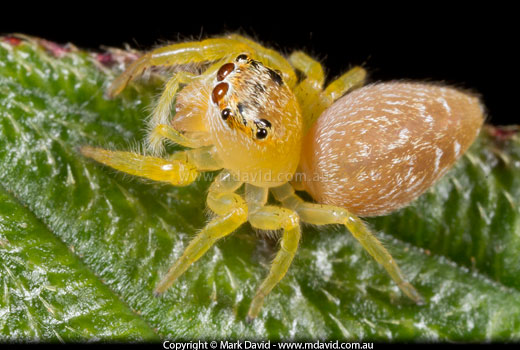
Jumping spiders are one of the most common types of spider, and some of the most beautiful too. There are literally thousands of different jumping spider species, and they are bundled into the family Salticidae. You can find them all over the world, and that can’t be a bad thing: they eat a lot of insect pests, including mosquitoes.
Most of the jumping spiders you will find are small. The ones I find are usually only about 4 to 8 millimetres long. Watch them for any length of time and there’s a good chance you’ll see why they call them jumping spiders. Because they really do jump.
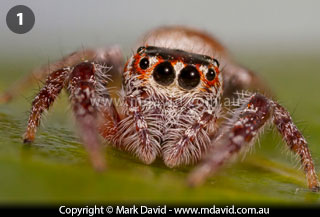
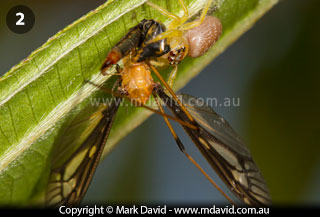
1: When a jumping spider turns to face you its large front eyes become very noticeable. 2: This jumping spider is dwarfed by the size of its meal. It was strong enough to carry that large winged insect around with no apparent effort.
If a jumping spider isn’t jumping then perhaps the easiest way to recognise it is by looking at its eyes. Yes, seriously. Even some of the smaller jumpers have eyes big enough to notice without a magnifying glass. Because they have excellent eyesight (for a spider) they will often turn around to face you and that’s when you’ll see what I’m talking about. The pictures on this page should give you a better idea about those prominent eyes.
Jumping spiders don’t hang around in a web all day. They go hunting for food. They will crawl slowly up to their prey and then jump onto it. These spiders can jump many times their body length and catch prey much bigger than themselves.
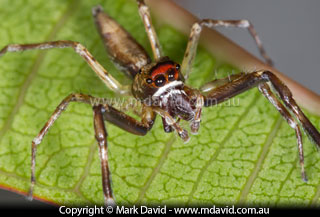
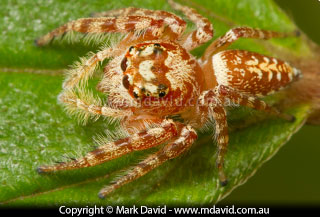
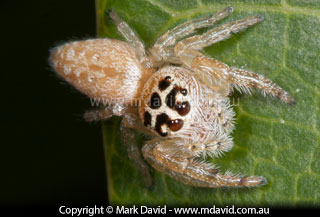
Smartly-patterned species photographed in NSW and Queensland.
One of the fun things about these spiders is their ‘curiosity’. Now, I’ve got to be careful here. Before you can truly say an animal is curious it has to show some thinking ability and a desire to learn. And we’re talking about spiders here, not Einstein. But they do seem to consistently investigate moving things, looking for food. That’s often helped me with my spider photos because, instead of me searching for them, they will often come out of their hiding space to investigate me. And to make things even better they will usually also turn to face me in a way that helps me get a better shot.
No. I don’t think of jumping spiders as dangerous. I’ve even heard of some people keeping them as pets. However I suggest caution when handling all types of spiders — partly because we’re constantly learning about and even discovering new species.
There is also the Northern Green Jumping Spider (Mopsus mormon), which can make some people sick if it bites them. And it’s possible for some people to be allergic to different things and that might include spider venom. Spiders’ fangs can also carry bacteria that might do you no good if it gets under your skin. But the main reason why I treat jumping spiders with care is because I don’t want to injure the spider.
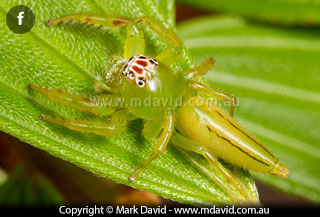
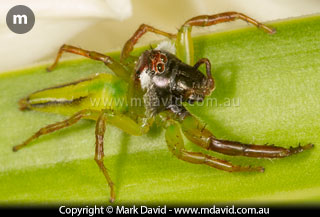
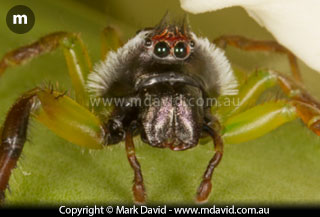
The Northern Green Jumping Spider is Australia’s largest jumping spider, and is unusual in that it can give a painful bite. That’s the female in the picture marked with the ‘f’ and of course the male marked ‘m’. These ones were in south-east Queensland. The distinctive front-on appearance of the male has earned the species the alternative name of Monkey-faced Jumping Spider.
I’ve had countless jumping spiders land on me while I’m taking photos and they don’t worry me. But those same cute little furry spiders would be pretty frightening if they were as big as us, because they seem to be tireless hunter-killer machines to their insect prey. When they wander into my room I like to think of them as my personal soldiers in the war against mosquitoes.


Copyright © Mark David. All rights reserved


