
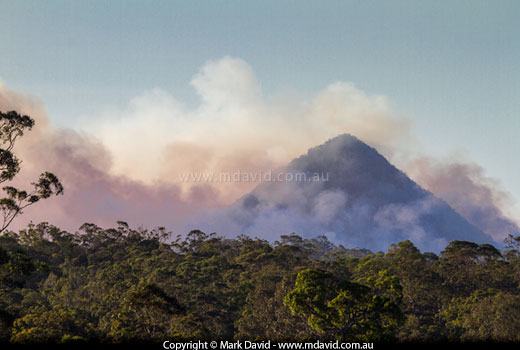
Before Europeans came to Australia, the aboriginal people used fire to help them manage their environment. They used a practice called mosaic burning. Mosaic burning is a system of using patches of small, low-intensity fires to sweep through the understorey of the bush. These fires didn’t normally develop into high-intensity destructive fires. That’s because fuel levels — the build-up of old and dead foliage — were kept at low levels by these fires.
These low-intensity fires are sometimes called ‘cool fires’. That might sound weird but it’s a good description because it draws attention to the fact that these fires don’t reach the extreme, destructive high temperatures of other types of fires. They had minimal impact on the wildlife too. The fires moved slowly and the animals could often run to safety.
This system favoured certain species of plants, including the Eucalpyts (gum trees). The frequency of fires might have helped the gum trees become a dominant feature of the Australian environment.
These days, controlled burns (also called hazard-reduction burns) are used to prevent fuel levels building up too much. These cooler types of deliberately-lit fires are also sometimes used to control weed infestations.
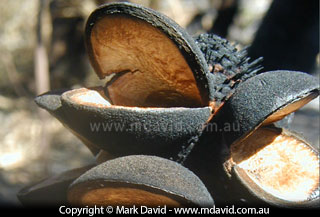
These Banksia seed pods have opened after a fire, allowing the seeds to fall to the ground.
Take a look at some Banksia seedpods and you might wonder how the seeds are supposed to get out. The seeds are safely stored inside. When a fire sweeps through the area the heat from the fire makes the seed pods open (see the photo below) and the seeds fall out, ready to germinate in the ash. Even if the fire killed the plant which made the seeds, the seeds will provide a new generation of that species in that area. There are many Australian plants which benefit from fires in a similar way.
Despite the fact that some species of plants need the heat from a fire to propagate, too many fires can actually be bad for them. Take the example of the Banksias mentioned above. If another fire sweeps through before the new plants have had a chance to reach seed-producing age then that species won’t be able to replace itself with another generation. It’s going to be the end for that species in that area.
Australia has the poorest soils of any continent on the planet. That’s because the volcanism, mountain formation and glaciation that creates new soils happened such a long time ago. In many parts of Australia the topsoil layer is very thin or doesn’t even exist at all. There are very few nutrients left in it.
When a fire sweeps through the bush, the wind carries nutrients away as particles in the smoke, to wash down in the rain into rivers or the ocean. So every time a bush fire burns a patch of the Australian bush it might be helping some species of plants to breed, but it’s also making the poor soils a tiny bit poorer.
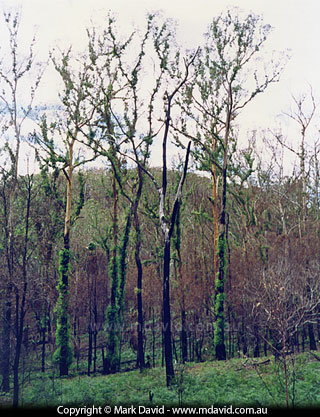
After surviving a bush fire these trees needed to replace their leaves in a hurry. Dormant buds under the bark, called epicormic buds, sprouted and in the following weeks the trees covered themselves with this fuzzy layer of new foliage.
If a fire burns slowly enough, and if it doesn’t generate enough heat, then many animals can often escape from a fire. Like the Banksias mentioned earlier, some animals can even benefit from fire. For example, wallabies like to nibble on the green shoots that spring up out of the charred ground in the weeks after a fire. All that fresh new growth everywhere can even lead to some animals increasing in numbers.
Unfortunately not all animals do okay in a fire. Koalas can suffer horrible burns. If they survive the fire then they can face the problem of their food supply being burnt out. And while they’re wandering along the ground looking for a new food tree they’re vulnerable to attacks by dogs.
So some animals can do okay with fires and others don’t do so well. But if the fire is a very hot, powerful fire, then almost every animal in its path has a very poor chance for survival.
It sounds odd to talk about ‘hot fires’ just like it does with ‘cool’ fires. Surely all fires are hot aren’t they? But when fuel levels build up enough the flames are able to reach the middle and top parts of the trees. That’s when you get an especially dangerous fire — much hotter, much faster and much more destructive than the aborigines’ mosaic burning.
Eucalypts (gum trees) can be especially dangerous in one of those ‘hot fires’. That’s because of the eucalyptus oil they produce. On high-temperature days the oil vapourises into the surrounding air, sometimes even giving a blue haze to the distant hills. That blue haze is what gave the Blue Mountains area, west of Sydney, its name. The blue haze might be pretty but it can be explosive during a fire, and it can cause whole gum trees to burst into flames ahead of the fire front.
Those hot fires burning all the way to the top of the trees are sometimes called crown fires. Crown fires are nasty fires. They often move too quickly for animals to escape and they can be so destructive, burning with such extreme heat, that nothing survives in their area at all. I remember one night as a teenager watching a crown fire burning a couple of miles from where I lived. The fire was so intense it was sending explosions of flame hundreds of feet above the trees, like glowing mushroom clouds. A week later I visited the area and was shocked to see that even the large old trees had vanished — leaves, branches and thick trunks all gone. There was nothing left but a field of grey ash. It was like the surface of the moon.
Fires which are as intense as that do much more damage than good to the environment and put wildlife, plants, housing and people at risk.
People often say that fire is good for the Australian bush. It’s true that after a ‘cool’ fire the Australian bush recovers quickly and that proper fire management is important. But we shouldn’t make the mistake of thinking every fire in the Australian bush is a good thing.


Copyright © Mark David. All rights reserved | Mark David on Google+


