
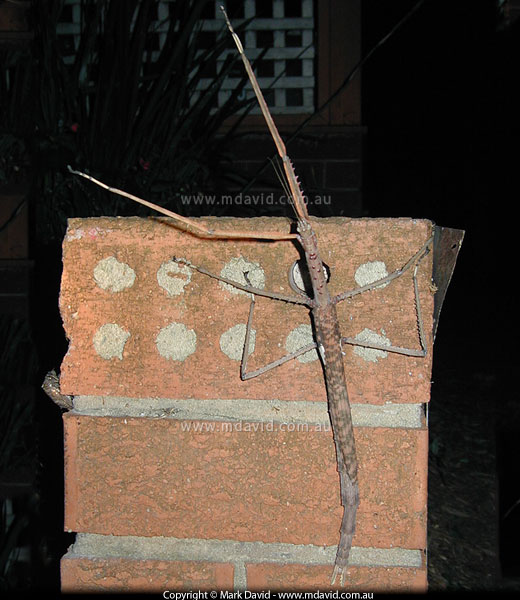
Most people would argue that a cicada was a big insect, but the abandoned cicada skin left hanging onto the brick in this photo is dwarfed by the Titan Stick Insect.
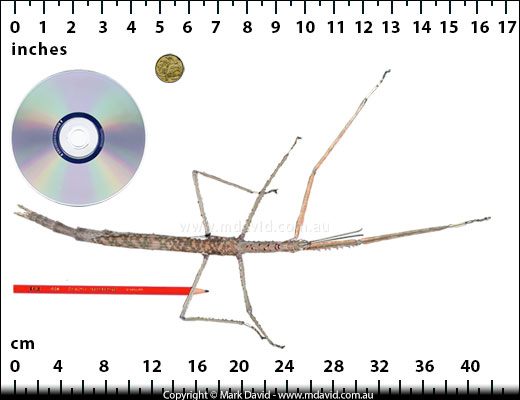
Its length, from the tip of the abdomen to the end of its front legs was an astonishing 42cm (16.5 inches). Length from its head to the end of its abdomen would have been approximately 25cm (almost 10 inches)
To give you a better idea of how big that is, I’ve merged a photo of it to the same scale as some familiar objects — a CD, an Australian one-dollar coin, and a pencil.
Of course I took photos of it.
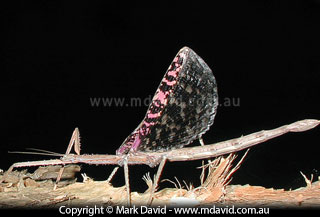
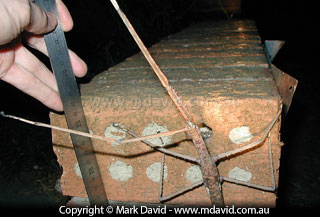
1: Female Titan with wings outstretched 2: Using a long steel ruler to measure it
Their food plants include Eucalyptus (gum trees), Babyberry, Bramble, Photinia, and Cypress Pine.
Titans live in the coastal regions of eastern Australia, from South-east Queensland through New South Wales to Victoria.
Titans normally hang around among the high branches but occasionally an injured one is found on the ground near one of their food trees. The males don’t grow as big as the females and they also have fully-developed wings. Therefore the males are good fliers.
Female titans lay a lot of eggs, which they flick away from themselves onto the ground. This scatters the eggs so the young will have a chance of finding another tree.
It’s not known if these insects are endangered because their camouflage is so good — they really do look like a thin branch — that it’s hard to know if there are a lot of them in the wild or not.
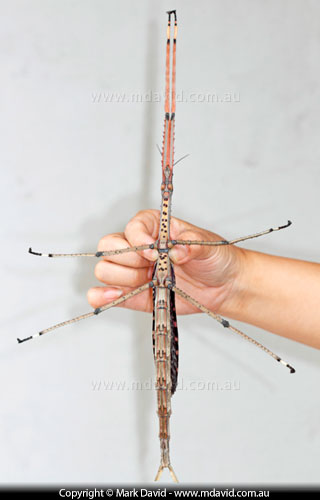
I found the stick insect shown here, possibly a female Titan, on a wall in a busy indoor shopping centre in Sydney’s eastern suburbs, at least a hundred metres from the nearest tree. Despite it clinging to a bare wall with a constant stream of people walking past, no one appeared to notice it until I picked it up. It just goes to show it’s worth keeping your eyes open for critters everywhere. As big as this one is, it’s nowhere near the maximum size of a female Titan.
No, it’s not. I’ve learned that some Australian stick insects get even bigger, reaching lengths of more than half a metre (if you include the oustretched legs). Paul Brock, one of the authors of this field guide, told me about one species, Ctenomorpha gargantua, reaching approximately 615 mm (once again, that’s if you include the outstretched legs). Next time you’re holding a tape measure just see for yourself how big that is. The book covers all the stick and leaf insects currently known in Australia.
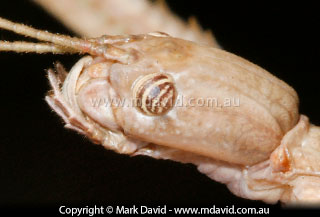
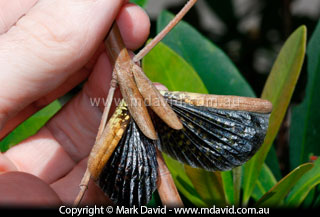
These two images show what is possibly a Ctenopmorpha marginipennis or Ctenopmorpha chronus.
There are more than a hundred species of stick insects in Australia. Identifying them isn’t easy — unless of course they’re as long as your arm, which certainly narrows the options down.
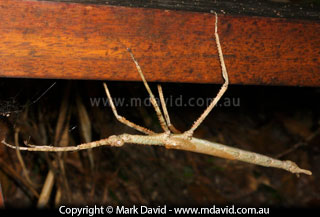
Possibly a ‘Strong Stick Insect’ — Anchiale briareus
The insects in these photos were only ‘small’ compared with a mature female Titan, being less than 12 inches long, counting the extended legs.
When you start thinking 12 inches is small for an insect, there’s a good chance it’s because you’ve encountered a Titan.


Copyright © Mark David. All rights reserved


