
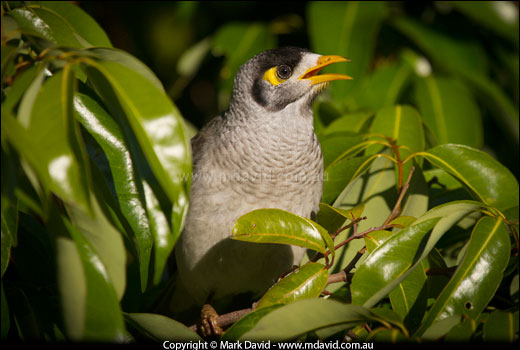
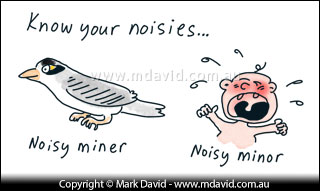
Noisy Miners are nectar-eating birds native to eastern Australia. They enjoy nectar (of course), fruit and the occasional insect. Noisy Miner is a good name for them, because of the repetitive noisy chirping they make, especially when there are young miners around. They can also make a whole lot of noise when an intruder enters their territory. That intruder could be another type of bird, or a monitor lizard, a cat, or even a person.
One of the reasons why these birds seem to benefit from people is their preference for areas with widely-spaced trees.
Suburban gardens fit that description perfectly, and they are further rewarded by the recent Australian interest in planting flowering nectar-rich indigenous trees and bushes like Grevilleas and Bottlebrush. Great food for Noisy Miners.
If Noisy Miners come across a garden full of flowering Grevilleas then chances are they will want to claim it as their own, driving away all other birds. So you plant a garden hoping to attact birds, and end up with a garden with Noisy Miners chirping all day.
I’ve heard of some people who use these birds instead of a door bell. The birds make such a lot of noise when visitors enter the birds’ territory that the home-owners know to expect company. But I once experienced something even more handy. A Sulphur-Crested Cockatoo had decided to chew up the shiny new guttering we’d put on our roof.
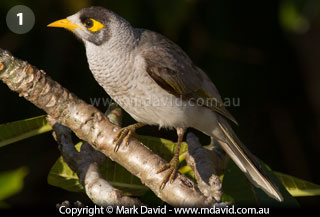
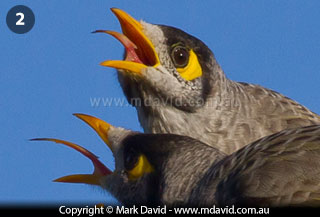
1: Noisy Miner 2: Noisy Miners have a long tongue to help them reach the nectar in flowers.
I wasn’t sure if its strong beak could damage the metalwork (they can easily chew through timber) but it sure was trying. I was wondering if I’d be having to replace that part of the gutters and then I heard an outrageous amount of noise. Four or five Noisy Miners were swooping at the cockatoo, despite the cockatoo being many times their size. Their attack was sustained, noisy and vigorous. The cockatoo was clearly flustered and finally gave up. It took off and never returned.
I admit I felt grateful to those Noisy Miners on that occasion. But is that kind of aggression in birds always a good thing?
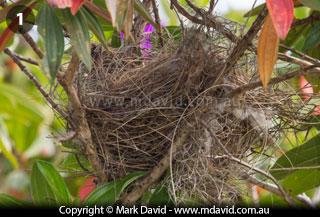
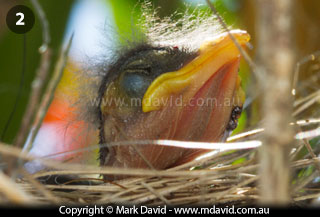
1: Noisy Miner nest 2: Very young Noisy Miner chick
It’s well known that Noisy Miners can drive away other birds from their territory. That was great for my gutters, but driving away all the other birds forces them to move into new areas where they’ll have to compete with the existing bird population for limited nesting spots and food. The Miners stay behind keeping all the best stuff for themselves.
But there’s another problem. When Noisy Miners drive away other birds, those other birds aren’t around any more to eat the insect pests in the area. This can cause trees to get very sick from all those insect parasites breeding up in the absence of avian predators. The Noisy Miners might eat the occasional insect but they aren’t really interested in that kind of food. It’s the nectar they want.
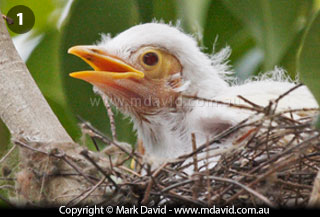
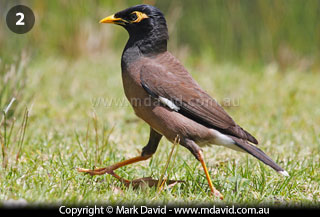
1: A pure white Noisy Miner chick in its nest 2: Indian Myna. Some people confuse this bird with the Noisy Miner. However the Indian Myna, with its chocolate-brown colouring, has quite a different appearance. The Indian Myna, unlike the Noisy Miner, is an introduced species. You can get a much better idea about the differences between the two birds here.
It seems their territorial behaviour runs in the family. Noisy Miners have a close relative called the Bell Miner (Manorina melanophrys) which is a type of bird well-known for causing forests to get sick. Bell Miners take over large patches of trees, driving away all the other birds. In the case of the Bell Miners, this is a problem for trees that are susceptible to lerps.
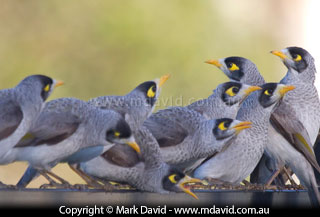
A group of Noisy Miners. Moments after I took this photo, these birds took off and began chasing a pair of Magpies.
You’re wondering what a lerp is, right? A lerp is a little sugary nest — it looks a bit like a tiny scallop shell — that is the home of a sap-sucking insect called a psyllid. Birds such as pardalotes love to eat lerps, which helps the trees a lot. But Bell Miners drive the pardelotes and other insectivores away, allowing the little sap-suckers and their sugary lerps to spread unchecked. The reason for this is because the greedy Bell Miners like to have all those tasty treats for themselves.
After Bell Miners have been around for a while you end up with a forest heavily infested with sap-sucking psyllids (try saying that fast three times). The trees start dying back, showing a distinctive blotchy brown pattern on their thinning foliage. If you see a bunch of gum trees with foliage speckled with red-brown blotches then you might be looking at a lerp infestation.
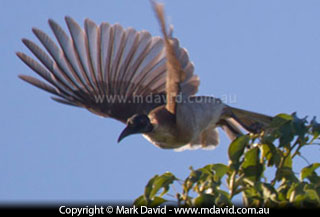
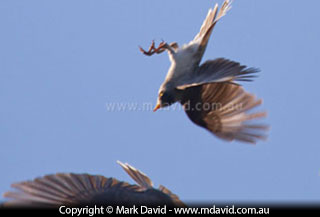
In the first shot in this sequence, a Friar Bird suddenly takes off from its perch at the top of a Camphor Laurel tree. The second shot captured the reason for the Friar Bird’s sudden departure: a Noisy Miner swooping in aggressively towards the larger bird. Prior to this little skirmish I’d had no idea that the Noisy Miner was even in the area.
Thankfully, the Miners often move on eventually and allow the forest to recover, but if a stand of trees is already suffering from changes due to land clearing, water diversion, compacted soil and other things that people can cause, then the trees find it that much harder to survive.
As is often the case, the answer is yes and no!
It’s true that Noisy Miners and Bell Miners are a natural part of the eastern Australian ecology, but people are changing nature in ways that give them an unfair advantage. First of all, we clear away all the thick shrubs that the smaller birds use for refuge. Then we plant lots of flowering trees which the Miners adore. Then we build roads through the forests and divert water drainage, which stresses trees in ways that make them less likely to survive or resist an onslaught of insect parasites. So, while the damage Miners cause is perfectly natural, their destructive impact is being made worse by the actions of people.

Copyright © Mark David. All rights reserved


