
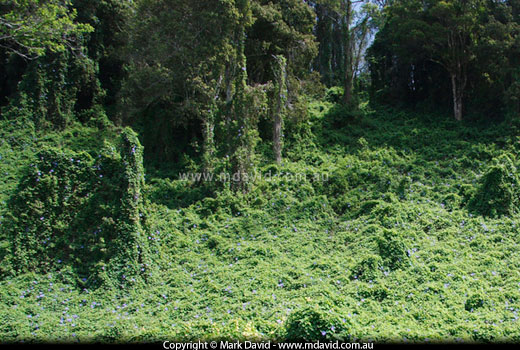
From a distance this hillside looked lush and green. Seeing it up close revealed that it was smothered in Mile-a-minute Vine
With all those flowers and the nectar they produced, the place was full of native birds too. And there were plenty of echidnas and goannas. And fish. I’d catch meal-sized fish from the harbour, using fresh Sydney rock oysters prized from the rocks as bait. I saw sharks, dolphins, giant fish, enormous mud crabs and a lot more amazing stuff than I could list here.
Then over the next twenty years a wave swept through. Not a wave made of water. It was a wave of change.
The larger trees are still there (except for the ones poisoned by neighbours working on their water views) but the shorter vegetation is very different now.
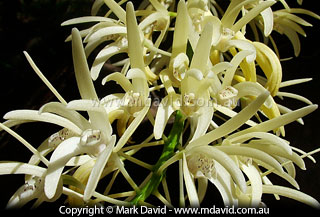
A spray of wild orchids
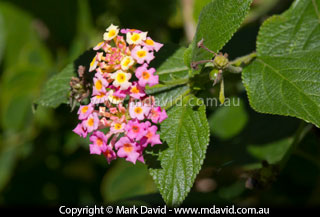
Lantana
The first to disappear were the orchids. You see, there was a lady in our street who liked orchids. She liked them so much that she’d go looking for them. When she found some she’d rip them out and take them back to plant in her own garden. They always died but that didn’t stop her going back for more. My sister and I once caught her pulling up a beautiful clump of wild orchids and said, ‘What are you doing?’
She jumped quite a bit and looked mighty guilty, stopped digging and started shoving butchered plant remnants back into the soil. ‘I’m just planting some flowers,’ she said.
Yeah right. We were only little kids but we weren’t stupid.
Of course the next day those wild bush orchids were gone and over the following years she managed to take out the lot.
My mum heard a bit of commotion one day and went outside to see a bunch of council dump trucks in our street. The council had been clearing Lantana from one of its parks. In Australia, Lantana is an aggressive introduced weed and because that type of Lantana is an artificial hybrid it’s madly difficult to find a biological control for it. So the council had several truckloads of the stuff which they’d ripped out of their parks, and wondered what to do with it. For some reason, they decided the best thing was to dump it over the cliff near where I lived — an act for which their own rangers would issue a fine if anyone else tried it. Within a short time the cuttings took root and spread for several acres, overwhelming all the small plants and growing so thickly that none of the kids in the street could play in the bush any more.
I’ve forgotten exactly when it happened, but for a while most of the boats moored nearby used a special kind of antifouling paint. Antifouling is something that stops barnacles and coral growing on the hull. Around that time, antifouling paint had some sort of nasty chemical thing in it which was super-poisonous. The year that paint was introduced all the oysters died in that part of the harbour. And not just the oysters. Everything else on the rocks died as a result of the chemicals leeching into the water from those antifouling paints. So the fish disappeared too. After all the shellfish died, a slimy brown algae gunk started growing over everything. It was crazy slippery when it was wet and it stank when it was dry.
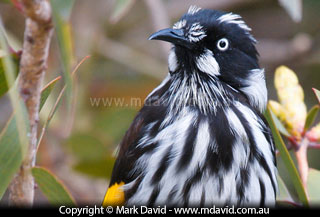
Native birds like this New Holland Honeyeater were common in the area. It’s been good to see them come back since locals starting planting flowering Australian trees in their gardens
After a while that type of antifouling paint was banned and the nature of the place started repairing itself. It all came back different of course, a different species of oyster and different fish and so on, but at least some stuff did start growing back.
Last time I went back I was left pretty sad by how much things have changed. For example, when I was a kid there were thousands of little frogs called Red-crowned Toadlets (Pseudophryne australis) living in the area. Pretty much any spot in the bush where rainwater trickled down the rocks and accumulated in shallow pools, you’d find them or their tadpoles. (No, in case you’re wondering, that’s not a Red-crowned Toadlet in the photo at the top of this page.) Well, those little guys became locally extinct in that area and in fact the frogs are now listed as a vulnerable species.
The funny thing is, most people in that street wouldn’t think anything has changed. They see green stuff (Lantana and Mile-a-minute Vine) and blue stuff (water views) and think this is how it’s been forever. But it hasn’t even been like it for 20 years. It’s changed drastically in a very short time.
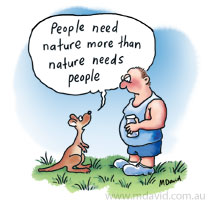
Everywhere I’ve been on this planet I’ve heard stories like this. Great waves of change sweeping across the environment, leaving natural places permanently changed. Aggressive introduced plants and feral animals, spreading over the landscape from one coast to the other, displacing indigenous species with their bland uniformity. Add climate change to the mix, and the challenges faced by plants and animals (including us) only become more urgent.
I’ve always been amazed that more people aren’t bothered by this. But then when you talk to people you quickly realise that it’s pretty hard for someone to care about a Red-crowned Toadlet if they’ve never heard of one.
And then there are the people who are so unfamiliar with the Australian bush, that they think we never even had spectacular wild orchids growing all through the Sydney region in the first place. They don’t even know what they’re missing.
Now, I’d be kidding myself if I thought I could change everything with a website like this one. For starters, I don’t know enough. But about a thousand people come to this web site every day. If some of the stuff here sparks some interest, then I’d be happy with that.
Copyright © Mark David. All rights reserved | Mark David on Google+