
Photography mdavid.com.au

Digital SLR photography — Why does a telephoto lens blur the background?

Published April 3, 2011

In the first page of this beginners’ guide to SLR photography I talked about the close relationships between depth of field, aperture and shutter speed. Aperture becomes a brilliant tool for controlling depth of field, especially in those instances where you want to blur the background away. But using a telephoto lens can soften the background too.

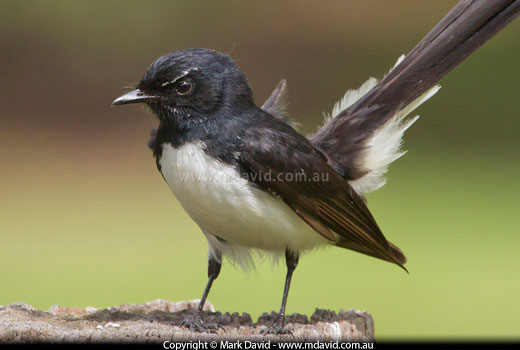
Willy Wagtail

A combination of aperture setting and focal length allowed me to reduce the cluttered background in this shot to just a blur. The bird, by the way, is a Willy Wagtail.

photo taken with a 50 mm lens photo taken with a 400 mm lens

Switching between a 50mm lens and a 400mm lens makes a huge difference to the background, despite the fact that the aperture is the same.

A lot of people get confused about depth of field. To put it simply, depth of field is the distance between the closest and most distant areas in focus. You can use a small depth of field to blur a background or you can use a telephoto lens to blur the background. Or you can use a combination of both. So, if depth of field is controlled by aperture, then what is that telephoto lens doing? Does that also involve depth of field?
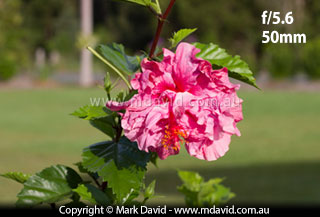
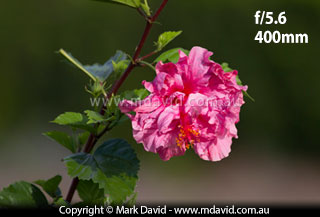
Take a look at the two photos at right. Both shots were taken with the same camera using the same aperture. The only difference was that I changed lenses. You’ll see right away that the background looks much softer in the 400mm shot.

Is the depth of field the same?

I would say it is! In both shots, the very same bits are in focus (the whole flower and none of the background).

So why is the background more out of focus in the 400mm shot?

Actually it’s not! What it is, is more ‘stretched’.
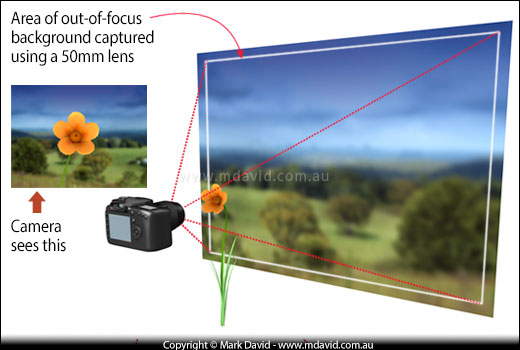
Illustration showing how a 50mm lens captures a lot of the background

To understand what’s going on, have a look at the diagram above. We’re starting with the 50mm lens. A 50mm lens takes in a sweeping, wide expanse of background behind your subject. That background might be out of focus but there will be a lot of it in the frame.
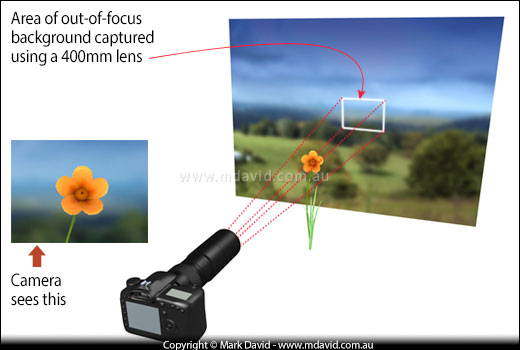
Illustration showing how a 400 mm lens captures only a small part of the background

Now look at the next diagram (above). This shows what the 400mm lens ‘sees’. Looking through the 400 is like looking through through a long pipe where you lose all your peripheral vision. The background is still out of focus but you’re only seeing a small patch of it, and that small patch fills the entire frame behind your subject.

Can you see now, what I meant when I said the 400mm (telephoto) lens ‘stretches’ a small patch of background in a way that makes it look softer?

It’s that stretching (or not stretching) which makes the backgrounds look so different. When you combine that effect with the depth of field controlled by your aperture, then suddenly you have a lot of power over how your shots turn out!

So if you want to make your subject really stand out — by getting it in sharp focus against a very, very soft backgrounnd — use your longest lens opened up to a nice big aperture (small f-stop number) and better still, try to have the background a long way behind your subject.

It’s not rocket science. What it is, is another cool trick you can use when you’re out taking photos.

Photography

Beginners’ series on digital SLR photography

The essential basics

Digital SLR photography — a beginners’ guide
A quick guide to understanding your new toy

Learning from examples
Picking up where the first article left off

Understanding aperture
This is one of the fundamental tools for controlling exposure.

Understanding shutter speed
This is another of the fundamental tools for controlling exposure.


Making sense of technical stuff

Megapixels
How many is enough?

How much camera gear do you need?
Sometimes, less really is more

How to choose a lens
Making the right choices can improve your shots and save you money

newTips for using tripods
Getting the most out of them

JPG versus RAW
Which is the best way to work?

Understanding histograms
Making sense of this handy tool

APS-C vs full frame
The differences explained, and what it means to your photography

Pixel density in sensors
Helping APS-C cameras photograph distant objects.

Fast lens, slow lens
What’s the difference?

Understanding colour temperature
It doesn’t have to be complicated.

Understanding resolution
What it means, as it applies to digital photography


Photography words explained

What’s a 100% crop?
I explain a term you often hear in digital photography

newWhat are specular highlights?
You’ll recognise them when you see them

newWhat is bracketing?
A commonly-used word for a handy trick


Photography at night

Photographing small critters
in the dark

How I take my shots when there’s no light

newTaking pictures of the moon
You need a fairly long lens, and these simple tricks

Common problems and their solutions

Washed-out colours in photos
Why it happens, and how to prevent it

Understanding exposure compensation
Why your photo subject can look so badly exposed, and what to do about it

Understanding dynamic range
Dealing with too much contrast

Working in harsh light
Getting some of the colour back into midday photography

Getting sharper pictures
Understanding the things that stop your photos from being tack-sharp

Noise in your images
What causes it, and what can you do about it?


Taking things further

Using a telephoto lens to blur the background
Here’s an easy-to-understand explanation of why it happens

Macro photography part 1
Using your DSLR for bug shots

Macro photography part 2
Ironing the bugs out of bug shots

One simple trick
The easiest way to get better wildlife photos

Wildlife photography
Tricks the pros use to get better pictures of critters

Bird photography part 1
Small, distant, and feathered does not have to mean a bad photo

Bird photography part 2
More hints for beginner bird photographers

How I take photos of frogs
These tiny critters require a technique all their own.

Using software to ‘fix’ your photos
A few suggestions for image editing


Advanced stuff

Image Stacking
Using software to achieve extraordinary Depth of Field

Sneaky deep-etching
A fast way to cut complicated objects out of their backgrounds


Other photography stuff

BLOG (sort of)

The elusive waterskiing duck
It started out as a fun idea …

PHOTO GALLERY

Pics of Australian critters
Some of my recent images

PHOTO SALES

Looking for the right picture?
A small selection of the photos available


Copyright © Mark David. All rights reserved