
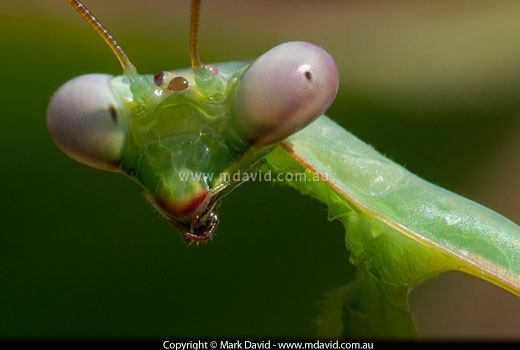
Macro photography, like this picture of a praying mantis, is one of the areas in which the size of the sensor makes a difference.
Digital SLR cameras have a sensor, which is the thing that takes the place of the film. The size of that sensor makes a big difference to how the camera behaves.
Back in the days when everyone used film, people often talked about using 35mm film in their SLR cameras. Now, when people refer to a full-frame digital camera, they’re talking about a camera with a sensor about the same size as a single full frame of 35mm film.
APS-C stands for Advanced Photo System type-C. Aren’t you glad you know that now?
Okay then, here’s how to make sense of that.
APS was a format of camera film that allowed a choice of three different formats. The ‘C’ added onto the end referred to what was called the ‘Classic’ option for using that type of film.
An APS-C sensor is smaller than a full-frame sensor. That means the edges of the image recorded by a full frame camera are cut off (cropped) by the APS-C sensor. The picture below will give you a rough idea of how much cropping I’m talking about. You’ll see that the full frame captures quite a lot more of the scene.
And because the APS-C sensor is smaller, it has a slight disadvantage in how much fine detail it can capture, simply because it is like an artist having to work with a smaller canvas.
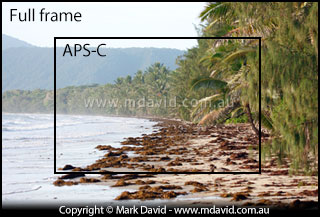
An APS-C sensor cuts off some of the edges of a scene, compared with a full-frame sensor.
Full frame sensors are bigger than APS-C and that makes them more expensive to make, which means more expensive cameras.
And because full frame has a bigger sensor it means they need wider-diameter lenses to work with them, which rules you out from buying some of the less expensive lenses made purely to fit over the smaller APS-C sensors.
And there can be advantages in APS-C. I’ll talk about those in a moment. But before I go on, I’ll point out that full frame cameras do the same things as APS-C. They work the same way. But because they capture different amounts of the scene, we can end up with slightly different images, and I’m talking about more than just how much gets saved or chopped off the sides.
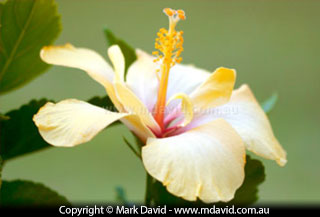
Increasing the background blurring allows the foreground subject to stand out more
Imagine you’re taking a photo of a flower with an APS-C camera. You’re standing close to the flower because you want it to fill the whole photo. Now imagine there’s some grass in the background. That grass looks kind of, well, grassy and distracting and so you want to blur it away so the flower will be more noticeable. So you open up your aperture as much as you can to reduce the depth of field, and that makes the grass look softer and more blurry than it already was. You take your shot. The grass is blurred and not as much of a distraction any more.
Now, you swap over to a full frame camera and look through the viewfinder. Same lens. Same camera settings. But, whoah! That flower no longer fills the frame. You’re seeing all the scenery around it that had been cropped by the APS-C camera. So what do you do? You can take the shot and crop your photo in your image editor, and end up with the same picture. Or you can move in closer to the flower.
Moving in closer does more than just bring your composition back to having the flower filling the frame again. Because you’re now standing physically closer to the flower, the perspective on the flower seems a little bit more extreme, perhaps a bit more dynamic. And now you’re focusing closer too. And when you focus closer something really important happens: depth of field gets smaller.
So that background grass is suddenly even more blurred, meaning that the flower stands out even more.
So you’ve got the same subject, the same lens, the same aperture and even the same composition, but the full frame camera has resulted in quite a different photo! In this case, you might prefer the full-frame camera.
You’re admiring your work when you see an insect on the flower which you hadn’t noticed before.
You have a macro lens and now you want to fill the photo with that insect.
At this point, the APS-C camera might be more helpful because you won’t have to stand as close to the insect to fill the frame. While that might be nice for people who don’t like getting close to critters, being at a greater distance also means you’re less likely to scare the insect. And in macro photography, trying not to frighten off your skittish subjects is a big deal and you’ll welcome the advantage you have from being able to work at a greater distance.
But that’s not all.
Because getting enough depth of field is notoriously difficult in macro photography, you’ll probably also appreciate the slight increase in depth of field that comes from photographing your insect at the greater distance.
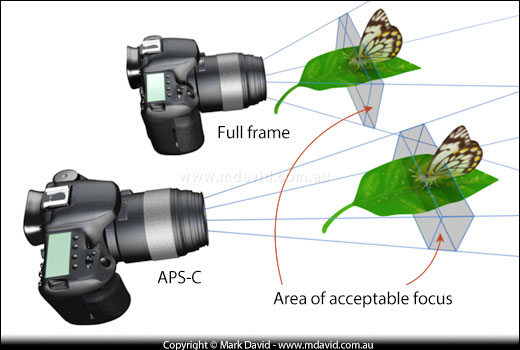
Depth of field increases as you move further away from your subject. This can give an APS-C camera an advantage when taking macro photos because they fill the frame with your subject from a greater distance. Note that this graphic is not drawn precisely to scale.
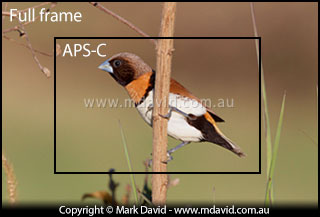
Having the sensor only capture the centre of a scene can sometimes work to your advantage
A bird suddenly lands on a plant about ten feet away. It’s a species new to science and photography. Well okay, in my example here it’s a Chestnut-breasted Mannikin which is a species that’s been photographed heaps of times, but it fills the frame nicely with the APS-C camera, but not so much on the full frame. Having an APS-C camera is like making your lens longer (more telephoto)!
Canon APS-C cameras like the 40D and 7D are often said to have a ‘crop factor’ of 1.6. Nikon APS-C cameras (also known as Nikon DX format) have a crop factor of about 1.5. The crop factor is sometimes called the multiplier factor because when you multiply it by the focal length of the lens, you see the difference in how the lens frames your scene. Now, I know that didn’t make much sense when I said it like that, so I’ll give you an example.
Put a 100mm lens on a full frame camera and it behaves like a 100mm lens. Well, of course it does. But put that same 100mm lens on an APS-C body with a 1.6 crop factor and it frames the scene like a 1.6 × 100 mm lens (a 160mm lens) would have done on a full-frame. What’s happening is, the APSC sensor is smaller and only big enough to capture the middle bits of what’s projected by the lens, which quite possibly is the most distant stuff in the scene. So your entire frame (and viewfinder) is now filled with the stuff you would normally have zoomed in on with a full frame camera.
And a 400mm lens on an APS-C camera will frame the scene like a gigantic 640mm lens on a full frame body. So using an APS-C camera is sort of like making your telephoto lenses longer, but not exactly the same. You see, the APS-C camera doesn’t actually magnify the image any more than the full frame. I mean, it’s still the same lens. Instead, the APSC camera only records the bit that would have been in the centre of a full-frame viewfinder and so it gives the impression that you’ve zoomed in more (like a longer focal length). This can still sometimes offer an advantage though, because if the pixels in the APS-C sensor are small enough and packed in densely enough then you can capture a lot of detail in a way that is almost as good as having that longer lens. In other words, the combination of the cropped sensor plus the “pixel density” really can result in some magnification advantages!
Yeah, I know how nerdy and complicated that last bit sounded. And if you want to understand that pixel density stuff better then I explain it in this short article. Otherwise, we can move on.
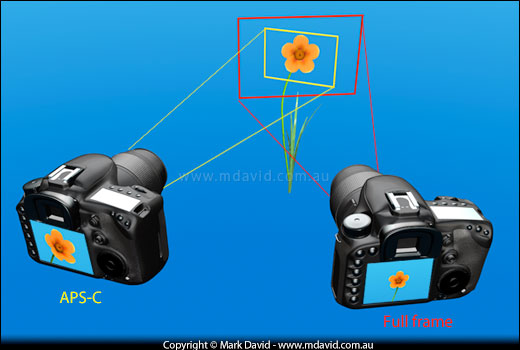
An APS-C camera and a full-frame camera with identical lenses would see different amounts of the same scene.
Anyway, by having an APS-C sensor, it’s like having all your lenses framing your shots like longer lenses would on the full frame cameras. That can be great for things like wildlife photography, where a lot of your subjects will most likely be a long way away. But not so good for wide angle photography. Because a full frame camera takes full advantage of the wide angle lenses, while the APS-C does not, due to the fact that the APS-C is cutting off all the outside bits of the wide-angle image, meaning that it’s not so wide-angle any more. For example, a 20mm wide angle lens would behave more like a not-nearly-so-wide 32mm lens on the APS-C. That’s not necessarily a deal breaker though, because there are some extreme wide-angle lenses available now (lenses with very short focal lengths) that can restore wide-angle photography for APS-C camera users.
Earlier on, I mentioned the analogy of the artist’s canvas and I want to come back to it now.
We now know that full frame sensors are bigger. So imagine you’re an artist trying to paint as much fine detail as possible onto a canvas. It makes sense that the bigger the canvas you’re working with, the easier that task is going to be.
Now, APS-C sensors might try to win back some advantage they lost in size by making their sensor pixels smaller. That’s like the artist still using a smaller canvas, but using a finer (narrower) brush to paint with. So APS-C cameras don’t have to be bad at capturing detail but they will struggle to record as much detail as a full full-frame sensor with the same sized sensor sensor pixels, because that’s like an artist using a really small brush on a really big canvas — you just know that artist is going to be able to capture the most details.
So now we know full-frame can be great for capturing details. The question is though, how much detail do you actually need to get a really nice photo. I can’t answer that question for you because that depends on what your preferences are, not mine. I can say though, that APS-C cameras used well can easily capture individual pores of skin in a portrait photo and I personally don’t see the need for any more detail than that. But what about if you want to print giant posters of extremely detailed scenes? Well then in that case you might want every advantage you can get, so the full frame could be a better choice.
Some lenses are designed to only work on cropped sensors. So if you have a full-frame camera, you might find yourself unable to use some of the lenses available for the APS-C models. Of course, if you’re buying a lens you should make sure at the camera store that it’s suitable for your camera body. However, some people with APS-C cameras choose to only buy lenses that will work on full-frame as well, because they might want to switch to full-frame later. That’s a personal preference of course and in my opinion it’s neither right or wrong. For example, they might plan to always stick with APS-C because it suits their photography. Alternatively, they might choose to eventually change to full frame. Only you will know what’s best for you.
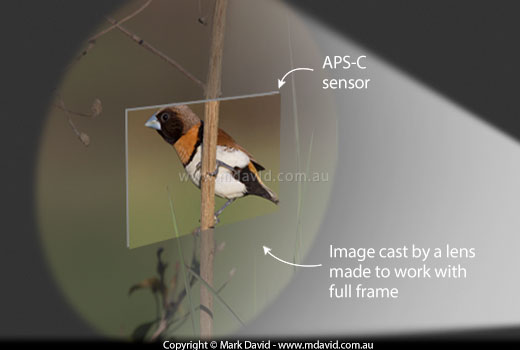
A full-frame compatible lens casts an image that’s more than big enough for an APS-C sensor.
Yep. Even though our photos come out as rectangles (the shape of our sensors), the image cast by our lenses is actually circular. If the circle of image is big enough to completely cover your sensor then you don’t have a problem.
The image cast by the full-frame lens is more than big enough for the little APS-C sensor. So you’ll lose the bits around the edge of what your lens is projecting but all of your sensor should work fine.
Technically, you’re not really making best use of your full-frame lens that way, but that’s never stopped me from using them on my APS-C camera and I’ve always been very happy with the quality I get.
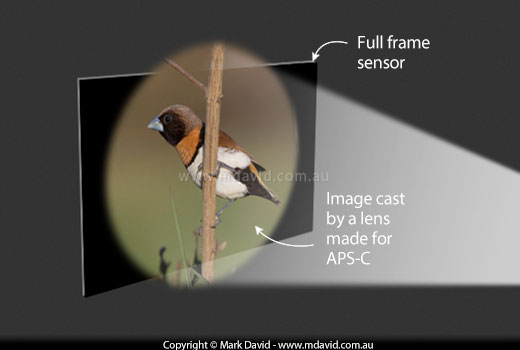
A lens made only for APS-C cameras casts an image that isn’t big enough for a full frame sensor.
A lens made for an APS-C camera will probably NOT work with a full frame camera. I don’t know about all manufacturers, but Canon modifies the mount for its APS-C lenses to prevent you from even trying to fit one to a full frame camera.
And even if you could mount an APS-C lens onto a full-frame body, the little image cast by the smaller glass in the APS-C lens will not be big enough to cover all of your full frame sensor. So you would theoretically end up with big black corners on your photo, like in the graphic shown above.
But it gets worse. Much worse.
Once again, I don’t know about all makes of cameras but with Canon, the camera and lens could be damaged if you force an APS-C lens onto a full frame body. The reason is because the mirror inside a full-frame camera (the one that flips when you take a shot) might be too big for the snug-fitting APS-C lens and so it might hit the lens and damage it when you take a shot. You just don’t want to break those delicate inside bits of cameras.
For those reasons I personally would not advise using an APS-C lens on a full frame body.
You might be seeing now how, just by changing the size of the sensor, it opens up all sorts of
interesting implications for lenses and photography. Remember that both kinds of cameras
can do all the same things, but they handle them a little bit differently. And those differences
are used to their maximum advantage by top photographers.
Copyright © Mark David. All rights reserved


