
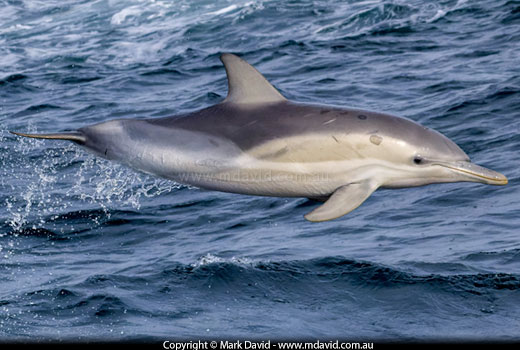
I had only a fraction of a second to get this photo of a Short-beaked Common Dolphin.
There are often rules about how close a watercraft or swimmer can get to whales and dolphins. I urge you to please follow those rules. It’s much better to miss out on some photos than to harass the cetaceans or risk a fine.
I once asked a highly successful dolphin photographer if he was psychic. Because he kept having his camera aimed precisely where a dolphin was about to surface. He laughed and told me that the trick was to really know your subject. And that struck a chord with me. Because it’s a rule that applies to every type of wildlife photography. If you know your subject well then you'll have a better track record of knowing where they’ll be, and therefore where to aim. So you can be ready for them. And it’s like that with whales and dolphins. When dolphins streak past your boat underwater, follow their movement and be ready for them to surface for a breath. Or if you’re dealing with highly energetic and playful Common Dolphins that enjoy riding waves, have your camera ready and aimed towards the bow or behind the stern of your boat.
My camera doesn’t have a “sport mode”. Sport mode is a bunch of settings saved into your camera that help you capture fast action and sports. It’s probably the best setting if your camera offers it or if you don’t feel confident doing all the configuring yourself. My camera doesn’t have a sport mode. It assumes I’ll want to choose my own settings. And it assumed correctly. So I’ll tell you what I do.
Taking fast bursts of photos instead of single shots will let you pluck the best shot out of a sequence. My camera can shoot 20 frames per second (fps) but I find that can be too many. At 20 fps I just fill up my camera card too quickly, and end up with dozens of shots that look the same. And when I’m shooting at that frame rate, I can run out of buffer and the camera might stop working at exactly the time the best action is happening. When I talk about running out of “buffer”, I mean the camera is unable to write my photos to its cards fast enough and the queue of new photos clogs up and everything stops working until the writing of files to the card has caught up with things. That can be madly annoying. So I use a slower setting (12 frames per second). I haven’t run into buffer problems since doing that. Chances are that you know what your camera and its buffer can handle.
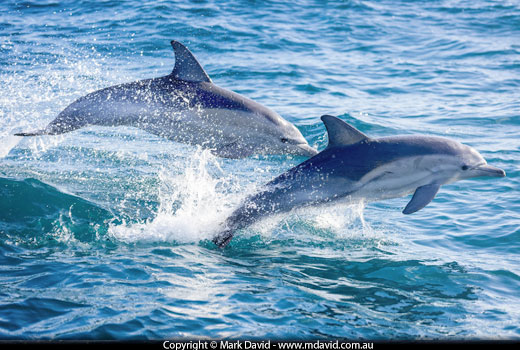
A couple of Short-beaked Common Dolphins
Dolphins move fast and so do the droplets of water splash around them. You need a fast shutter speed to avoid huge amounts of motion blur. So work with a shutter speed that is FAST. In the photo of the Short-beaked Common Dolphin at the top of this page, I was shooting at 3,200th second. That’s how I froze all that splashy dolphin action. To get an exposure in 3,200th of a second most likely requires that your aperture is open a lot to let enough light in, PLUS you might need a high ISO setting. ISO settings tell your camera how much to amplify the signal from the light hitting its sensor. A high ISO setting will get your camera to really make things look lighter and brighter. But some cameras handle high ISO better than others. Go too high with the ISO and you can end up with a lot of pixel noise. So you’ll have to know what your camera can manage. The photo of the Short-beaked Common was taken with the ISO set at 6,400. I was shooting in aperture priority mode, so the shutter speed of 3,200th of a second was selected by the camera automatically. If the sunlight fades a bit and shutter speeds start to slow down, then I tend to crank the ISO higher. If the light gets brighter then I tend to choose a smaller aperture (bigger f/number).
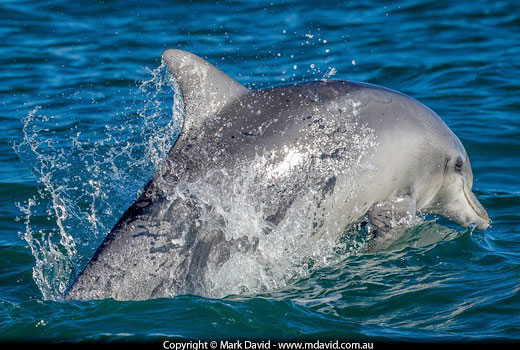
Bottlenose Dolphin photographed in South Australia
You’re working with fast-moving subjects and you want to avoid motion blur. That means a fast shutter speed, as we already know, but you can trick your camera into selecting a fast shutter speed by using a big aperture and high ISO. The lens I was using was not a particularly “fast” lens. It was a 100-500 mm zoom that maxes out at f/7.1 at its long end. So I will often shoot at apertures like f/7.1. But the photo above was taken at f/16. That tells me it must have been quite sunny at the time, because it means I closed down the aperture a bit to stop things getting too bright and overexposed. My camera displays a little hologram inside my viewfinder as I shoot, so I know if my photos are being properly exposed or not.
If you end up with a small aperture (big f/number) like I did in that shot, then you’re going to also end up with more depth of field. That most likely helped me get most of the dolphin looking sharp, although the background waves ended up fairly clear too, which makes them a bit distracting.
I find it too difficult to keep a single tiny focus point nailed over fast-moving random subjects so I make it a bit easier for myself by choosing a single-point focus point that is allowed to “expand” to surrounding areas if the subject moves. Different cameras have different names for these things, but what I’m saying is that it can help if you have more than just a tiny central point in your viewfinder set for focusing.
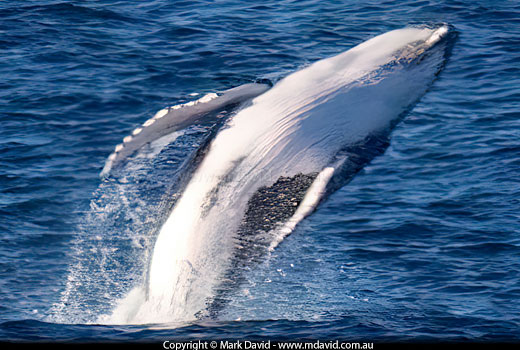
Humpback Whale breaching in SE Queensland
This bit is madly important. When a dolphin leaps out of the water you barely have time to notice it, let alone to see it, take aim, focus, compose your shot, and shoot. Try to guess how far away the whale/dolphin action is likely to happen and where you think it will happen, and have your camera already focused and ready to fire at that spot. That will allow you to hit the shutter button the instant you’re aware of some action.
This depends on how far away the dolphins and whales will be.
With rules prohibiting boats from getting close to whales, you’ll appreciate the reach you get from a long lens. A lens that can zoom up to 400mm or 500mm will come in handy. If you have whales breaching right near your boat then forget about long lenses. My personal experience with whales has been from working at a distance.
The lens I use when photographing dolphins from a boat is a 100-500mm. At the long end, it lets me capture action from a distance. But if the dolphins swim right up alongside the boat then even 100mm will be too much telephoto. Also, if a dolphin jumps nearby then good luck finding it in the viewfinder when you're shooting at 100mm, and at 500mm you’re almost certain to miss the shot altogether. Or you might get lucky and capture a part of the dolphin, like for example a bit of its tail, but it’s exasperating trying to get the whole dolphin in the frame from close up and at 500mm. In fact, the dolphin is just too big so I’ll call it impossible.
Not very much
We already know that we can’t be too certain where your subject will appear in the water so you don’t want to limit your range by being zoomed in on just one tiny part of the water. Increase your chances by zooming out a bit. Or zooming out a lot. Then pre-focus on the distance at where you think the action will be and keep it like that until you sense that a dolphin is about to surface. Then zoom in a bit but don’t try to zoom in too tightly because you’ll be bound to zoom in too much and you’ll cut off part of the dolphin in your photo. So, keep your camera zoomed out enough to capture more of the scene. That will increase your chances of some action happening inside your shot.
The photo at the top of the page was heavily cropped because the dolphin appeared in the side of my photo. If I’d been zoomed right in then much of the dolphin would have been cut off. It really is crazy-difficult to get breaching dolphins in the centre of the frame because you just don’t get enough time to aim properly. A fraction of a second and then the dolphin is back underwater.
I know. I know. I’m talking you out of using a long lens! I guess, for me, the thrill is in getting the dolphin action filling as much of the frame as possible. Plus, I hand my better images to some dolphin researchers who benefit from getting high-definition shots showing the scarring of dorsal fins (Those details let the researchers identify the individual dolphins.) So that’s part of the reason why I like to have access to 500mm. But if a long lens makes your life difficult then use a shorter one. I won’t mind and I’m pretty sure the dolphins won’t mind either.
The more you practice, the better you’ll get at this. Because you’ll start getting a feel for where to aim. But even after lots of practice you will likely still have days when nothing seems to work out. Don’t be discouraged by that. The truth is, dolphins and whales don’t make it easy. On days when things don’t work out, just remember to enjoy being in the presence of some of our oceans’ most beautiful and intelligent creatures.
Copyright © Mark David. All rights reserved


